Written By | Business Experts
Export bans, tyre-plant ambitions and the smallholder squeeze in Côte d'Ivoire, Ghana, Liberia, Cameroon and Nigeria
Economic & Social Transformation
For most of the past two decades, Africa's natural rubber story has been told as a production miracle. Côte d'Ivoire, a country better known as the world's cocoa superpower, lifted output from 164,138 tonnes in 2005 to roughly 2 million tonnes in 2025, according to the Association of Natural Rubber Professionals of Côte d'Ivoire (APROMAC). That is a twelve-fold rise in twenty years, and it has turned the Gulf of Guinea into one of the few places outside Southeast Asia where the tyre industry's most important natural raw material is grown at scale.
Yet 2026 has marked a turning point in how West and Central African governments think about the crop. In quick succession, Côte d'Ivoire froze new permits for first-stage processing plants, Ghana restricted raw rubber exports, and Liberia banned the export of unprocessed rubber outright from 1 July 2026. The common goal is what Ivorian policymakers call the deuxième transformation: turning block rubber into tyres, belts, seals and moulded technical goods at home. The question is whether that ambition can be achieved without squeezing the roughly 180,000 Ivorian smallholders, and many thousands more in Ghana and Liberia, who made the boom possible.
A boom built on cocoa's troubles
APROMAC's figures, released at an industry event in Abidjan in November 2026, put 2025 output at about 2 million tonnes, up 11.1% from 1.8 million tonnes in 2024. The Ministry of Agriculture's own count is somewhat lower, at 1.85 million tonnes (up 9.9%), but on either measure Côte d'Ivoire is now Africa's dominant producer, accounting for about 82% of continental output in 2023, and among the top three in the world. Exports exceeded 1.87 million tonnes in 2025, and the Agriculture Minister has cited export earnings of around CFA 1,900 billion, making rubber the country's most important agricultural export after cocoa.
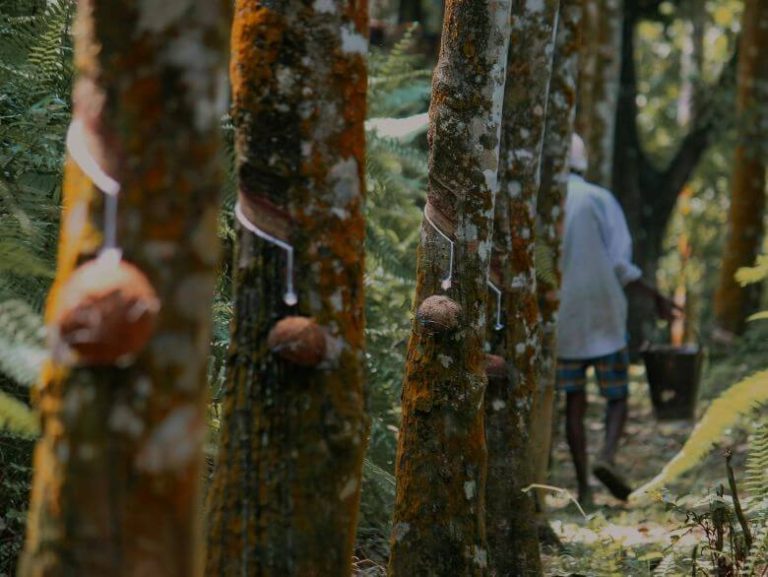
The driver has been a quiet reallocation of land and labour. Farmers facing volatile cocoa prices, ageing trees and disease have planted hevea because a mature rubber tree can be tapped for much of the year, producing a steady monthly cash flow rather than one or two harvest windows. That income-smoothing feature matters enormously for rural households with school fees and health costs to meet. The trade-off is the five to seven years it takes before a newly planted tree can be tapped, which means today's output reflects investment decisions made in the late 2010s, and that the plantations now maturing will keep supply rising for at least another five years, according to processing companies quoted by Daba Finance.
APROMAC expects 2026 output to hold near 2 million tonnes as the industry focuses on quality and traceability. It has launched programmes to map plantations and register producers, a step that will become increasingly important as European and other buyers tighten sourcing rules on deforestation and land use.
The first-transformation ceiling
Côte d'Ivoire's achievement is not only agronomic. Unlike many commodity exporters, it already processes most of its rubber into technically specified rubber (TSR) before shipping. The country has about 50 processing plants with combined annual capacity of more than 2 million tonnes, according to APROMAC president Charles-Emmanuel Yacé. Consolidation is under way: on 17 August 2026, Singapore-based Olam Agri completed its acquisition of Asia Africa Rubber Industry (ASAF), whose plant at Azaguié Aoua can process 176,000 tonnes a year, nearly doubling Olam's Ivorian capacity to about 352,000 tonnes. Earlier, in January 2026, BRVM-listed SAPH bought the 2,871-hectare SCASO concession near its Rapides Grah site to secure more latex. China's Mainland Group, which entered the country in 2018, says its five factories have about 480,000 tonnes of capacity and directly employ around 2,500 people.
Precisely because primary capacity now matches or exceeds national output, the sector regulator, the Conseil Hévéa-Palmier à Huile-Coco (CHPHC), decided in June 2025 to stop authorising new first-stage plants or extensions. The message to investors is clear: further money should flow downstream into manufactured rubber products.
Market access is moving in the same direction. Since 1 May 2026, China has applied zero tariffs to imports from the 53 African countries with which it has diplomatic relations, a change Ivorian officials in San Pedro have welcomed as a new outlet for semi-finished rubber. But the export structure remains concentrated: based on 2024 data, Malaysia, itself a large glove and tyre manufacturing hub, absorbed about 90% of Ivorian rubber exports by value. In effect, Côte d'Ivoire supplies the raw input for value addition that happens in Asia.
Export bans spread west: Ghana and Liberia
Ghana and Liberia have chosen a blunter instrument. Ghana's restrictions on raw rubber exports, which industry groups and the Business & Financial Times have described as a ten-year ban but which the Rubber Processors Association of Ghana (RUPAG) calls temporary, were designed to feed a domestic processing industry that had been running far below capacity. Industry data cited in Ghanaian media put 2025 national output at about 110,800 tonnes against installed processing capacity of roughly 171,460 tonnes, and the country's oldest processor, GREL, had warned a parliamentary committee that it might have to close a factory because cup lumps were being shipped raw to Asian buyers.
Early data suggest the policy has at least redirected volumes. RUPAG reported in July 2026 that local processors bought about 30,967 tonnes (dry) of raw rubber in January–June 2026, up 43% from 21,627 tonnes a year earlier. Purchases from traders and aggregators more than doubled, from 5,987 to 13,431 tonnes, while direct purchases from farmers rose 12%, from 15,640 to 17,535 tonnes. The association says processors paid above the monthly minimum factory-gate prices set by the Tree Crops Development Authority, and it projects that local value addition could generate about US$1.36 billion in additional foreign exchange and GHS326 million in additional tax revenue between 2026 and 2031. Market intelligence firm Helixtap had estimated that Ghana supplied about 15.2% of Malaysia's natural rubber imports, which underlines how much raw material was previously leaving the country.
Liberia's move is more symbolic still. A century after the Firestone Natural Rubber Company established large-scale rubber in the country, President Joseph Nyuma Boakai's Executive Order No. 166 banned exports of raw, unprocessed rubber with effect from 1 July 2026, alongside measures meant to protect smallholders. Rubber matters far more to Liberia's external accounts than to Ghana's: it made up an estimated 33.5% of export proceeds in 2024, and central bank figures cited by AFP put 2025 output at 73,769 tonnes. The government has also set a regulated farm-gate price, reported at US$690 per tonne in March 2026, with farmers netting about US$657 after a US$27 government tax and small levies for producer associations. Brokers and some smallholders argue that the ban hands pricing power to a handful of processors and pushes farmers to the margins, a criticism echoed by traders in Ghana.
Central Africa's cautionary tale
Cameroon offers a sobering reminder that owning plantations and factories does not guarantee profits. Hevecam and Sudcam, controlled by China's Hainan Rubber through Singapore-based Halcyon Agri, reported combined net losses of US$73 million (about CFA 43.2 billion) across 2024 and 2025, according to filings on the Shanghai Stock Exchange analysed by Cameroun24. Losses widened to US$40.79 million in 2025 even as revenue rose from US$45.24 million to US$56.88 million. By the end of 2025, the two companies had combined negative equity of US$111.54 million, and on 19 May 2026 shareholders approved new guarantee facilities of up to US$115.96 million. Hainan Rubber has blamed under-used land, heavy fixed costs and the expense of running schools and hospitals for plantation communities, and it books a CNY78.79 million receivable from Cameroon's finance ministry for social spending it says it advanced.
Cameroon is also home to the continent's most ambitious downstream bet. Cameroon Tyres Factory Project SA, linked to businessman Antoine Ndzengue's Neptune Holding, plans a 7.6-million-tyre-a-year plant at Bekoko near Douala. India's GHV Infra Projects received a letter of intent in May 2026 for an EPC contract worth €630 million, and the Central African States Development Bank (BDEAC) approved a CFA 65.6 billion loan in December 2024. But as of November 2026 the construction contract had not been signed and full financial close, including hoped-for Afreximbank participation, had not been documented. The project illustrates both the appetite for the second transformation and the gap between announcements and concrete.
A favourable but fickle market
Timing is on the producers' side for now. The Association of Natural Rubber Producing Countries (ANRPC) expects global consumption to exceed production by about 317,000 tonnes in 2026, and prices for two key tyre grades rose roughly 6–8% month-on-month in September on tight supply and steady downstream demand. A sustained deficit gives African processors bargaining power and makes it easier to pass better prices to farmers.
But rubber prices are notoriously cyclical, linked to car sales, oil prices (which set the cost of synthetic substitutes) and Asian weather. Export bans work best when domestic buyers compete vigorously; when prices fall, a captive market can quickly become a buyers' market. Nigeria shows the other side of the coin: despite ample suitable land, the country processes nearly all its modest output into TSR, but ageing trees and low replanting have kept volumes small, with leading producer Okomu Oil Palm reporting about 9,097 tonnes of dry rubber from 7,334 hectares.
What would make the second transformation work
Several lessons emerge from the region's experiments. First, price transmission to farmers must be monitored, not assumed. Ghana's minimum factory-gate price and Liberia's regulated price are useful tools, but they need transparent publication, independent verification and a clear mechanism for adjusting to world prices, otherwise bans become a hidden tax on smallholders.
Second, tyre manufacturing is a scale, energy and logistics business. A competitive plant needs reliable power, carbon black, steel cord, synthetic rubber and chemical inputs, as well as access to markets far larger than any single West African economy. That argues for a regional strategy under the African Continental Free Trade Area, with plants serving ECOWAS and CEMAC demand rather than every producer chasing its own factory.
Third, traceability is becoming a condition of market access. APROMAC's plantation-mapping work, and similar efforts in Ghana and Liberia, will determine whether African rubber can enter supply chains that face deforestation rules in Europe and growing scrutiny from global tyre makers.
Finally, the Cameroonian experience shows that social obligations on plantation companies need to be priced and shared honestly between firms and the state. Plantation enclaves that double as public-service providers can become financially fragile, with workers and communities bearing the risk.
Conclusion
Africa's rubber belt has already proven it can grow and process a strategic industrial commodity at world scale. The 2026 wave of export bans and permit freezes reflects a reasonable impatience to capture more of the value that currently accrues in Malaysia, China and Europe. Whether it succeeds will depend less on prohibitions than on what follows them: credible downstream investment, competitive farm-gate prices and regional markets large enough to justify tyre plants. If those pieces come together, rubber could become one of the clearest examples of agriculture-led industrialisation on the continent. If they do not, the bans risk shifting value from farmers to processors without creating the factories that were promised.