ENTERTAINMENT & CULTURE
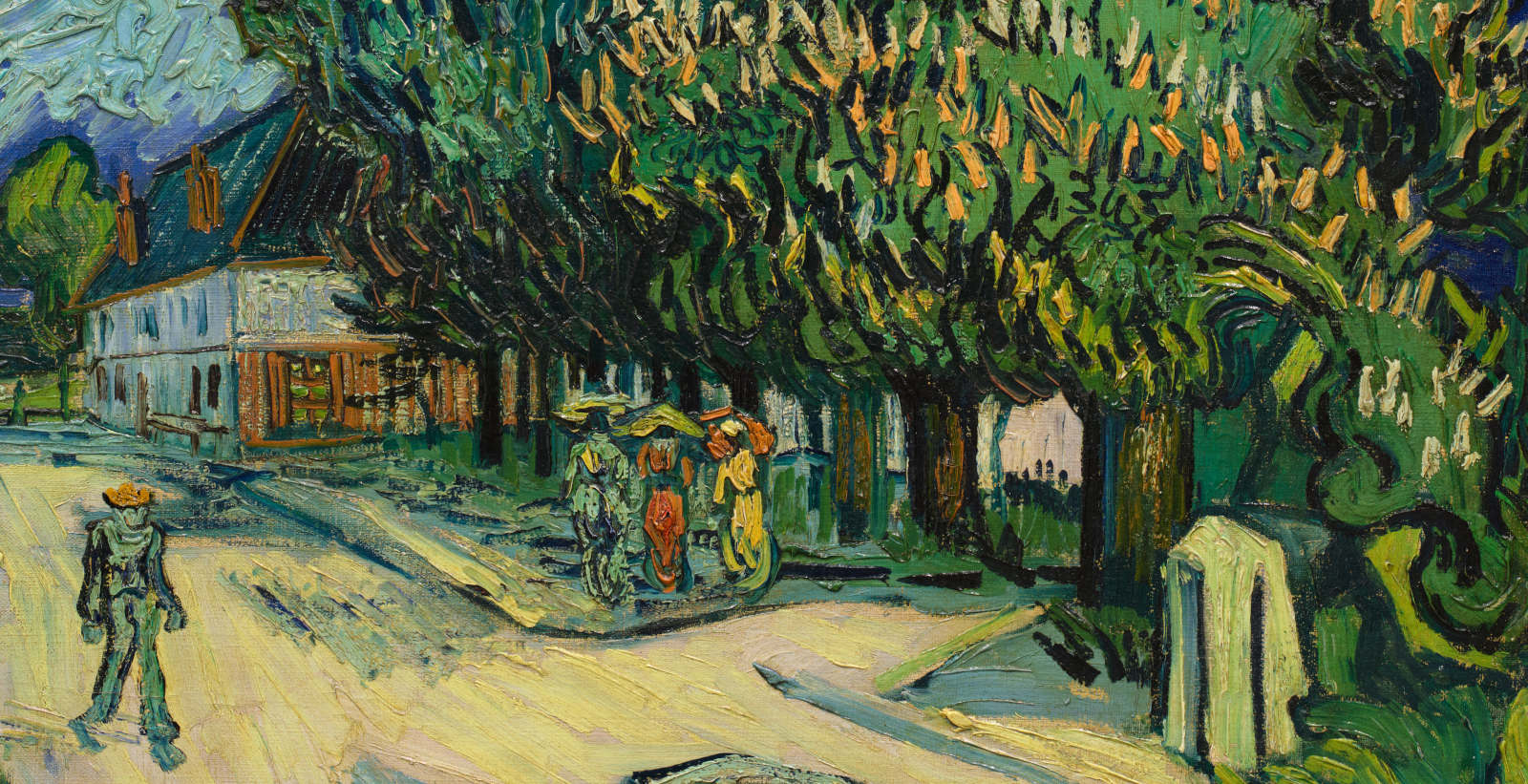
Days after a last-minute settlement with the heirs of a Jewish publisher who sold it in the Nazi era, a canvas painted two months before the artist's death became the most expensive Van Gogh ever auctioned, and one of the priciest artworks in history.
NEW YORK
It took about three minutes. On Wednesday evening at Sotheby's in New York, Vincent van Gogh's "Châtaigniers en fleurs" (Chestnut Trees in Blossom) sold for $190.4 million after a brief bidding battle, obliterating the artist's previous public auction record of $117.2 million. Euronews reported that the result makes it the fourth most expensive artwork ever sold at auction. The buyer was not identified.
The record alone would have made headlines. But the painting arrived in the saleroom trailing a provenance dispute that, until Tuesday, threatened to pull it from the sale altogether.

The painting
Van Gogh painted the canvas in May 1890 in Auvers-sur-Oise, the village north of Paris where he spent the final weeks of his life; he died there that July. The 70-by-58-centimetre oil shows chestnut trees in full flower, painted in the dense, rhythmic brushwork of his last period. Before the sale, Sotheby's estimated it at about $180 million, roughly $207 million with fees, and had guaranteed the result, according to The Art Newspaper.
The previous record, set at Christie's in New York in November 2022, belonged to "Orchard with Cypresses" (1888), which sold for $117.2 million. Wednesday's price beat it by more than $70 million.
A last-minute settlement
The painting's ownership history is where the story turns serious. Berlin publisher Samuel Fischer and his wife, Hedwig, acquired it in 1909. In 1936, three years into Nazi rule and three months after the family had moved from Berlin to Vienna, it was sold to Paris collectors Henriette and Marcel Kapferer. The Argentine Blaquier family bought it in 1975 and owned it for more than half a century.
On November 12, Gunnar Schnabel, a Berlin-based restitution researcher representing the Fischer heirs, wrote to Sotheby's challenging the 1936 sale. He asked the auction house to prove the painting had been sold at market value and that the family would have sold it regardless of the political situation, and he asked for the auction to be delayed. The heirs said the family had parted with the painting only because of financial losses suffered under the Nazis. Sotheby's said its own research did not support the claim that the work was sold under duress.
Then, on November 17, the day before the sale, Sotheby's announced that "an agreement has been reached between the Blaquier-Arrieta family and all of the legal descendants of Hedwig and Samuel Fischer." The terms were not disclosed. In a statement released through Sotheby's, the heirs thanked the auction house and the Blaquier-Arrieta family for the negotiation, saying it acknowledged their family's suffering in the Nazi era and honoured the efforts of Gisela Bermann Fischer, Samuel and Hedwig's granddaughter, to seek justice. The Blaquier-Arrieta family said they were pleased to have reached an amicable resolution.

A collection with "mythical status"
The Van Gogh was the headline lot from the collection of the late Argentine businessman Carlos Pedro Blaquier and his wife, the art patron Nelly Arrieta de Blaquier. The 12 paintings offered from the collection brought in almost $412 million, the Associated Press reported, via KSL. Cézanne's "Arlequin," described as the only work from the artist's Harlequin series not held by a museum, sold for more than $111 million. Renoir's "En Canot (Jeune fille à la barque)" made $27.5 million, and Monet's "Le Jardin des Tuileries" fetched $20.23 million.
Helena Newman, Sotheby's chair of Europe, said the collection had achieved "legendary mythical status," calling it "one of the greatest remaining collections of Impressionist and Post-Impressionist art in private hands."
The bigger picture
The sale comes at the heart of New York's November marquee auctions at Sotheby's, Christie's, Phillips and Bonhams, which were expected to generate about $2.4 billion. It has already been a week of records. Christie's sold Wassily Kandinsky's "Betonte Ecken" for $85.8 million, a high for the artist, for a work the Guggenheim once sold for $62,000. A Yayoi Kusama "Infinity Net" painting set her record at $15.1 million on Monday. And Christie's withdrew a Frida Kahlo work hours before its planned sale, saying it needed "further research," after reports that the painting had gone missing from a Mexico City museum.
For an art market that has spent the past two years talking about cooling demand, a nine-figure Van Gogh is a strong signal that the very top end is still alive, provided the work is rare, fresh to market and comes with a story.
Expert perspective: why provenance now moves markets
The Fischer episode shows how quickly provenance has become central to high-end collecting. Restitution claims over works that changed hands between 1933 and 1945 have become far more common over the past two decades. Collectors at this level want title they can trust. Settling with the heirs before the sale, rather than fighting a claim afterwards, probably protected both the price and the buyer. It also gave the Fischer descendants formal recognition, which in these cases often matters as much as money.
What this means for you
Most of us won't be bidding nine figures. Still, the sale is a reminder of how much the stories behind objects affect their value. If you collect art, antiques or even vintage design pieces, keep receipts, letters and gallery records, because documented history adds value and gaps in it can become a liability. If you simply love Van Gogh, keep an eye out: record-setting works often reappear in museum loan exhibitions, and the publicity around this sale may bring the painting before a wider public.
Conclusion
Van Gogh famously struggled to sell his work during his lifetime. A spring scene he painted weeks before he died has now sold for more than any of his paintings ever has. The price may get the headlines, but the story underneath is about memory and justice: a family's loss in the 1930s, acknowledged in a conference room in 2026, minutes before the auctioneer's hammer fell.
Published By | Entertainment Editor