Written By | Bosco Bakwatanisa
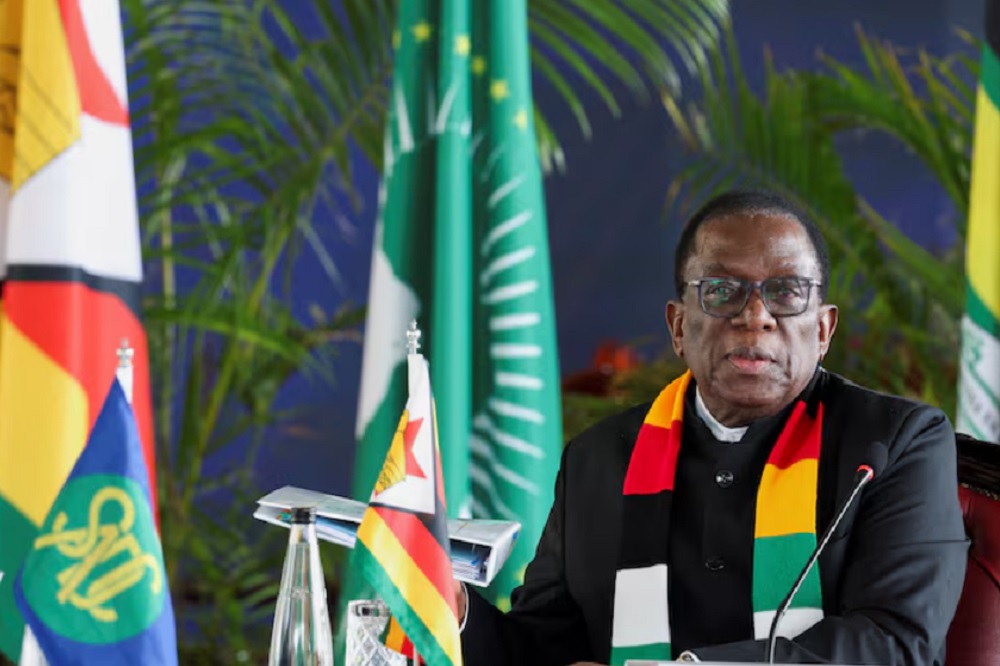
A seven-judge bench heard the applications in Harare on Wednesday, Nov. 18. Judicial sources told My Zimbabwe News that a ruling could come around January 2027, but the court has not announced a date
HARARE, Zimbabwe
The Hearing
Zimbabwe's Constitutional Court has reserved judgment in two consolidated challenges to the constitutional amendment that keeps President Emmerson Mnangagwa in office until 2030. The decision leaves the most consequential legal fight in the country's recent history unresolved. It may also stay unresolved for weeks.
A seven-judge bench heard the applications in Harare on Wednesday, Nov. 18. Judicial sources told My Zimbabwe News that a ruling could come around January 2027, but the court has not announced a date. Until it rules, the Constitution of Zimbabwe Amendment (No. 3) Act, gazetted as Act No. 6 of 2026, remains in force. That law extends presidential and parliamentary terms from five years to seven and ends the direct election of the president by voters.
The hearing took place under heavy security. According to NewZimbabwe.com, police blocked scores of liberation war veterans who tried to attend, and journalists were denied entry to the courtroom. My Zimbabwe News reported that the public gallery was filled to capacity. Barring the war veterans was itself a political statement. The veterans have historically been a pillar of the ruling ZANU-PF, and some of them are now among the amendment's most vocal opponents.
The stakes are plain. If the court upholds the act, Zimbabwe's next general elections move from 2028 to 2030. Future presidents will then be chosen by legislators rather than citizens. If it strikes down the act, or bars the extensions from benefiting people already in office, the country's political calendar and the ruling party's succession arrangements would be thrown open again.
What the Amendment Does
Mnangagwa signed the amendment into law on July 7, 2026, according to Human Rights Watch. Parliament had approved it the previous month. AllAfrica, citing Zimbabwean reporting, said it passed with the unanimous support of ZANU-PF legislators in both houses. The push began with a ZANU-PF resolution in October 2025. The party said a longer term was needed to "ensure continuity, stability and the sustained transformation of the nation."
The act goes well beyond term length. Under its provisions, as summarized by AllAfrica and My Zimbabwe News:
The government has argued that longer terms support policy continuity. The act states that "national development programmes benefit from stability and continuity of policies and legislative frameworks." Opposition parties, civil society groups and constitutional lawyers counter that the changes reduce public participation and concentrate power in Parliament and the executive.
Mnangagwa came to power after the 2017 military takeover that ended Robert Mugabe's rule. He was elected in 2018 and reelected in 2023. Under the 2013 Constitution's limit of two five-year terms, he would have had to step down in 2028. Human Rights Watch noted that he had previously described himself as a "constitutionalist" who would "abide by the provisions of [the] constitution to the letter."
The Two Challenges
The consolidated cases attack the amendment from two directions. Both applicants are represented by constitutional law professor Lovemore Madhuku, who leads the National Constitutional Assembly.
The process challenge. Vhurande Mahlupeko, a National Constitutional Assembly member, challenges how Parliament handled the bill in case CCZ 277/26. His lawyers argue that about 10 substantive provisions were added while the bill was before Parliament, including provisions expanding the Constitutional Court itself, and that these did not appear in the original Government Gazette notice. That notice began a consultation process that requires at least 90 days of public publication before proposals go to Parliament. NewZimbabwe.com reported that the applicants say the additions breached Section 328(3) of the Constitution.
Madhuku asked the court to set aside the entire act rather than strip out only the disputed provisions. He argued that partial removal would leave a law different from the one legislators actually voted on. "We don't know why people voted for this particular Bill," he said, according to NewZimbabwe.com.
The government countered that the memorandum accompanying the bill allowed Parliament to consider governance and other matters beyond the original proposals.
The incumbency challenge. Prince Dubeko Sibanda, a former opposition legislator, relies in case CCZ 271/26 on Section 328(7) of the Constitution. That provision says an amendment extending the length of time a person may hold office does not apply to someone who held that office before the amendment. In Sibanda's reading, the safeguard blocks the longer terms from benefiting Mnangagwa and the sitting legislators who voted for them. His application also argues that Mnangagwa had a conflict of interest in signing a bill that benefited him personally and should have recused himself.
The amendment's drafters anticipated the objection. The act's wording applies the extensions "notwithstanding" Section 328(7). Madhuku said Parliament did not dispute that Section 328 contains those requirements and argued instead that they "were overridden by the expression 'notwithstanding'." Madhuku rejected that position: "'Notwithstanding' cannot be a basis for you to shy away from the obligation."
According to Madhuku, the state also focused on jurisdiction. It argued that Sibanda's application does not qualify for direct access to the Constitutional Court and should have started in a lower court.
A Court Reshaped by the Law It Is Judging
One of the more delicate features of the case is that the amendment altered the very court now reviewing it. The hearing was first scheduled for Nov. 11 but was postponed by a week while the court reconstituted its bench. My Zimbabwe News and Nehanda Radio reported that judges promoted after the amendment was passed stepped aside over concerns about sitting in cases that challenge the same law.
The recusals were an important signal, because the court's legitimacy is part of what is on trial. Critics have argued that a court expanded under a contested law cannot credibly rule on that law. A bench that excludes the newly elevated judges partly answers that objection, though not entirely, since the process challenge specifically targets the provisions that expanded the court.
Part of a Wider Legal Campaign
The Nov. 18 hearing is one front in a broader legal campaign. In September, Nehanda Radio reported that four challenges were removed from the court roll, a move Madhuku then described as "simply a procedural step." The others include:
The referendum argument may be the most dangerous for the government. Zimbabwe's Constitution requires approval in a national referendum for amendments to certain parts of the charter, including its Declaration of Rights. Opponents argue that taking the choice of president away from voters is a structural change that legislators cannot make on their own. The courts have yet to rule on that question.
The courts have so far not been receptive to the challengers. Human Rights Watch reported that an earlier bid by Madhuku to halt the amendment process was dismissed on procedural grounds. Repeated postponements, roll removals and reserved judgments have meant that the law took effect in July and has stayed in effect while litigation continues.
Analysis: Delay Favors the Incumbent
The likeliest short-term outcome is no outcome at all. If the court does not rule until around January, the act will have been in force for roughly six months by then, and each month of delay normalizes the new order. Electoral administration has already begun shifting to the Registrar-General and a presidentially appointed Delimitation Commission. Unwinding those institutional changes grows harder the longer they stand.
Opposition supporters have long questioned the Constitutional Court's independence on core political questions, a skepticism that hardened after it upheld Mnangagwa's disputed 2018 election victory. Still, the legal questions here are unusually sharp. Section 328(7) was written specifically to stop incumbents from extending their own tenure, and the government's main defense rests on a single word, "notwithstanding." A court inclined to find a middle path could uphold most of the amendment while ruling that the extensions apply only to future officeholders. That would preserve the law's architecture and still require elections in 2028.
Such a ruling would not end the political fight, which is as much about ZANU-PF's internal succession as about the Constitution. The extension pushes back any transition to a successor. Some in the party and among the war veterans had been positioning for that transition ahead of 2028. The police barring war veterans from the courtroom shows how far the dispute has reached into the ruling coalition's own base.
What to Watch
For now, as Nehanda Radio put it, "the law remains in force."