Written By | Health News Agencies
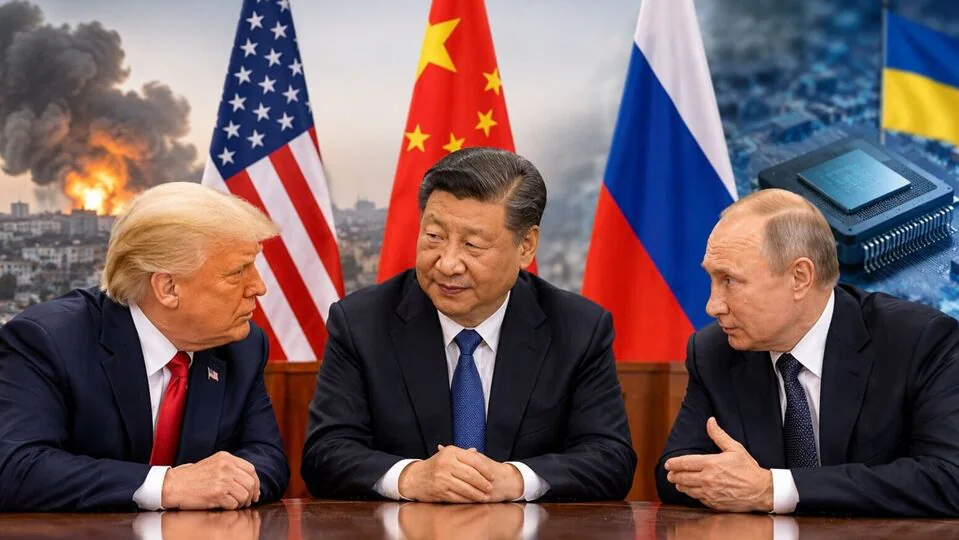
For the first time, the leaders of the world's three largest nuclear powers are scheduled to sit down together in a single room.
World Politics
For the first time, the leaders of the world's three largest nuclear powers are scheduled to sit down together in a single room. On Friday, November 13, the White House confirmed that President Donald Trump, Chinese President Xi Jinping and Russian President Vladimir Putin will hold a trilateral meeting on the sidelines of the Asia-Pacific Economic Cooperation (APEC) summit in Shenzhen, China. By Saturday the Kremlin had pinned down the date. "An agreement has been reached to hold a trilateral meeting on the 19th between President Putin, Chairman Xi and President Trump," spokesman Dmitry Peskov told the Russian state news agency TASS.
The announcement turns what had been a speculative idea floated last month into one of the most closely watched diplomatic events of the year. It also arrives at a delicate moment for each of the three leaders: Trump is fresh from a bruising midterm defeat at home and mired in a deadlocked war with Iran; Putin is pressing his advantage in Ukraine while U.S. envoys shuttle between Moscow and Kyiv; and Xi is hosting an APEC gathering of 21 economies meant to showcase China as a defender of open trade. What the three men can actually agree on, however, is far less clear than the symbolism of the photograph they will produce.
Background: From Trial Balloon to Confirmed Summit
The idea of a three-way meeting surfaced publicly in October, when talk of a U.S.-Russia-China leaders' session began circulating ahead of APEC. At the time, Peskov told the Wall Street Journal that there was "no clear understanding yet regarding the meeting itself or its potential agenda," while Secretary of State Marco Rubio said there had been "talks of a meeting." Ukraine reacted sharply. Foreign Minister Andrii Sybiha wrote on October 19 that a U.S.-Russia-China summit would encourage Putin to continue the war, arguing that inviting him "would feed his appetite for self-aggrandizement."
The relationships that make the meeting possible have been built over years. According to the Associated Press, Trump and Xi have met face to face eight times, most recently during Xi's state visit to Washington in September, and reached a truce after a short-lived trade war last year. Trump and Putin have met seven times, most recently in Alaska in August 2025. Putin and Xi, meanwhile, have met more than 40 times since Xi took power in 2013, and China has become Russia's most important trading partner and its main supplier of key technologies.
APEC itself runs November 18 and 19 in Shenzhen, the southern Chinese technology hub that Beijing has been eager to show off. Reporting compiled from multiple outlets indicates Trump and Xi will hold their own bilateral meeting before the three-way session, and that no separate one-on-one between Trump and Putin is planned.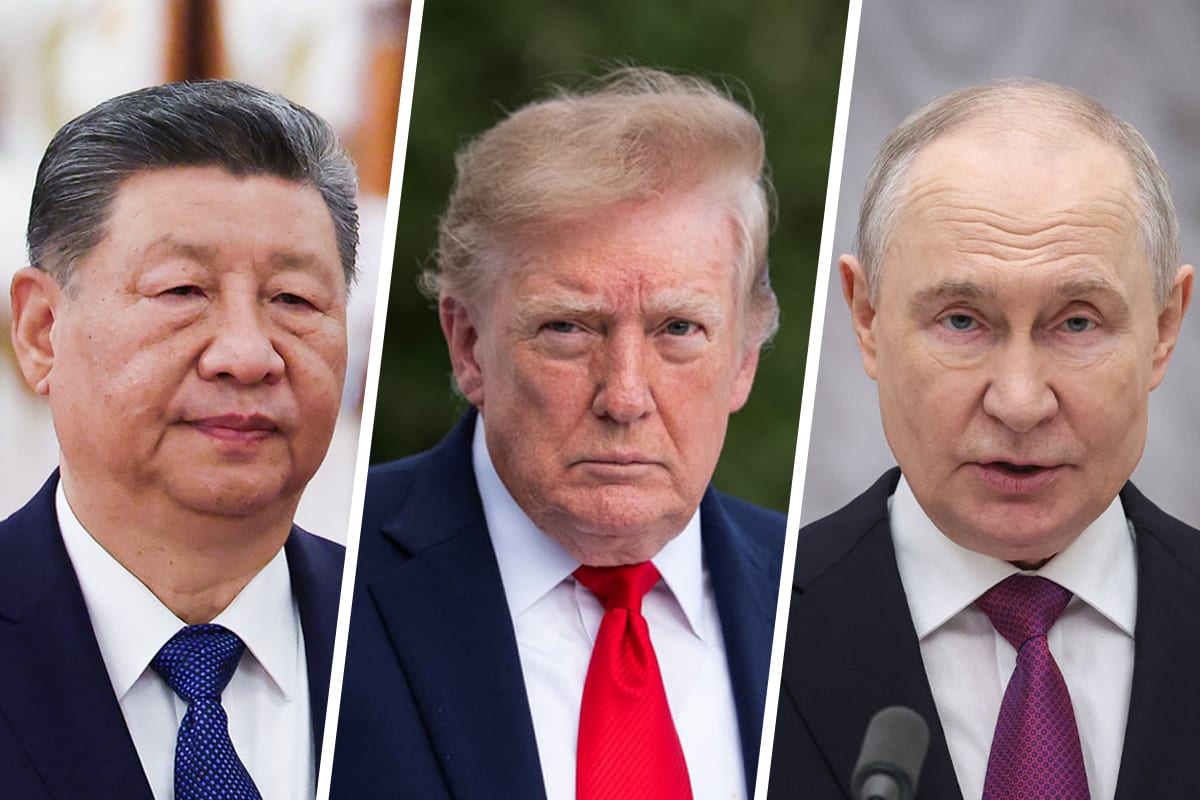
The Agenda: Nuclear Arms First
The White House has framed the meeting primarily around nuclear weapons. Spokeswoman Olivia Wales said Trump would discuss "the reduction of nuclear weapons in the world." The urgency is real: the New START treaty, the last arms-control agreement limiting U.S. and Russian strategic arsenals, expired in February, leaving the two largest nuclear stockpiles without binding caps for the first time in more than half a century. Trump rejected a Russian proposal to extend the treaty by a year and has instead called for "a new, improved and modernized" deal that would also bring in China.
That is where the ambition runs into reality. The Pentagon estimates China has more than 600 warheads, compared with more than 5,000 each for the United States and Russia, and Beijing has long argued that the two larger powers must cut first. Al Jazeera reported that China's Foreign Ministry described trilateral nuclear disarmament talks as unrealistic at this stage as recently as last month. A senior U.S. official, quoted by the AP, described the Shenzhen session as the "beginning of hopefully a conversation" and said it would be a chance for China to "step up ... to the adult table." Another official, quoted by Reuters via Al Jazeera, was blunter: "We do not expect to get to any kind of agreement."
The second item is Iran. The U.S.-Israeli war on Iran began on February 28, and while full-scale strikes have largely paused, the conflict remains unresolved and the Strait of Hormuz has been effectively closed for more than 100 days. That matters enormously to Beijing, which before the war received roughly a third of its crude oil through the strait, and it matters to Moscow, which has benefited from higher energy prices and recent U.S. sanctions relief on Russian fuel. CBS and the AP reported that Trump intends to raise the war. The broader backdrop remains volatile: on the same day the Kremlin confirmed the date, Iran's Revolutionary Guard navy claimed two oil tankers had struck mines south of the strait and caught fire.
Trade and technology are also in the background. Washington and Beijing have cut tariffs and struck deals after earlier meetings, but the relationship has been jolted by the Nvidia affair, in which U.S. officials reportedly believe an associate of chief executive Jensen Huang was working for Chinese intelligence, an allegation Beijing denies. A senior U.S. official said that matter was "probably not something that we're going to read the Chinese in on at this moment."
Ukraine: The Elephant Left Outside the Room
The most striking feature of the planned agenda is what it omits. A senior U.S. official told reporters Trump will not raise the war in Ukraine in Shenzhen, explaining that "China is not a part of that process." Washington's peace effort runs on a separate track through envoys Steve Witkoff and Jared Kushner, who brokered trilateral adviser-level talks with Russian and Ukrainian officials in Abu Dhabi on November 10 and 11. Those talks produced a prisoner-exchange arrangement but no ceasefire. Days later, President Volodymyr Zelenskyy said U.S. negotiators had for the first time asked whether Ukraine would withdraw from the Donbas in exchange for NATO membership.
Against that backdrop, Kyiv is uneasy. Zelenskyy has voiced concern that the Shenzhen meeting could become a platform for discussing a Ukraine settlement behind Ukraine's back, according to the AP and Al Jazeera. Edgard Kagan, a former U.S. ambassador to Malaysia now at the Center for Strategic and International Studies, told the AP that the meeting signals to Putin "a desire to talk to the president and talk to Chairman Xi" in a way that can suggest the three are making decisions on Ukraine, regardless of what is formally on the agenda.
Reactions and Competing Narratives
The framing of the summit differs sharply depending on who is talking. Russian lawmaker Pyotr Tolstoy suggested the meeting could lead to a "new Yalta," a reference to the 1945 conference at which Allied leaders shaped the postwar order in Europe. Several Western outlets, including Al Jazeera and The Guardian, picked up the comparison. Peskov, however, dismissed it, calling the meeting "extremely significant" while insisting that any agreements reached in Shenzhen could not be imposed on other countries and that a global order should be "based entirely on mutual benefit and mutual respect."
Analysts are largely skeptical that substance will match spectacle. Simon Mabon of Lancaster University told Al Jazeera he expects a performative event rather than real peacemaking, noting that the three leaders cannot end the conflicts in Iran or Ukraine on their own. Russia analyst Alexander Bratersky described the meeting as an opportunity for Putin to appear "first among equals." Hoo Tiang Boon of Nanyang Technological University told the AP that the gathering could undercut Beijing's carefully cultivated image as a champion of free trade and multilateralism, and complicate its argument that Western "Cold War mentality" helped cause the war in Ukraine.
Coverage across outlets also varies on details. A media comparison by the aggregator Newscord noted that Al Jazeera and The New York Times reported that Elon Musk would travel with Trump but not attend the meeting, a detail many other outlets did not report. Some Arabic- and Spanish-language outlets framed the summit as aimed primarily at ending the Iran war, while most English-language coverage centered on nuclear arms. These discrepancies reflect how little official detail has been released about the format and agenda.
What Each Leader Wants
For Putin, the value is largely about status. Analysts across outlets agree that sitting as a peer alongside the presidents of the United States and China, nearly five years into a war that the West sought to make him a pariah over, is itself a win. For Xi, the meeting is a chance to display China's growing clout on home soil, though the AP noted Beijing was the least certain of the three about the summit's value, and it wants above all an end to the Iran war that is squeezing its energy supply, without being drawn into a nuclear treaty it did not help design.
For Trump, the summit offers the kind of high-stakes, leader-to-leader diplomacy he favors, and a chance to claim leadership on arms control. But his position has weakened. Democrats won control of Congress in the November 3 midterms, and analysts quoted by Al Jazeera suggest a Democrat-led Congress is likely to push for stronger support for Ukraine, constraining any concessions to Moscow. Trump has also recently eased some restrictions on Russian oil and diesel sales, drawing criticism from Kyiv and its European backers.
What's Next
The immediate sequence is now set: APEC opens in Shenzhen on November 18, the Trump-Xi bilateral is expected before the trilateral, and the three-way session is scheduled for Thursday, November 19. Officials on all sides have lowered expectations, and the most likely outcome is a statement of intent to keep talking about nuclear risk reduction rather than any binding commitment.
Still, the meeting's significance may lie less in what is signed than in what it signals. A photograph of the three leaders together will be read in Kyiv, in European capitals, in Tehran and in Taipei as a statement about who sets the terms of world order in 2026. Whether that image becomes the start of a genuine arms-control process, a quiet bargain over Iran and energy, or merely a moment of theater will depend on talks whose details, so far, none of the three governments has been willing to spell out.