Economic & Social Transformation
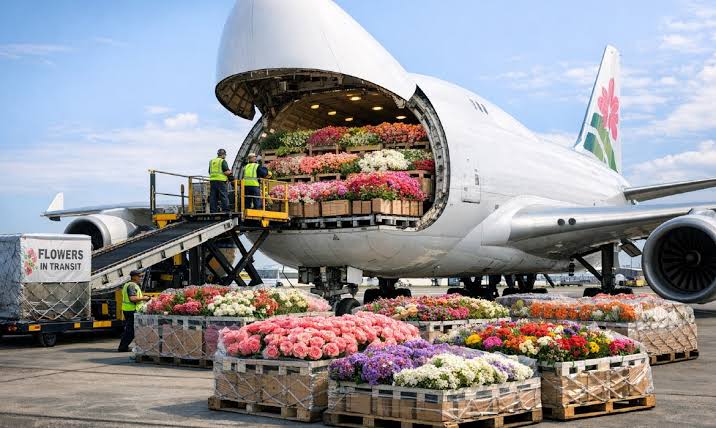
Few African export industries are as exposed to a single input as cut flowers. A rose harvested in Naivasha or Holeta in the morning must be graded, packed, cooled and loaded into the belly of an aircraft within hours if it is to reach an auction clock in Aalsmeer or a supermarket shelf in Europe with its vase life intact. That model built a multi-billion-dollar export base in the Rift Valley and the Ethiopian highlands, and it employs hundreds of thousands of workers, most of them women. In 2026 it was stress-tested as never before. The conflict that erupted in the Gulf on 28 February 2026 disrupted the Doha, Dubai and Abu Dhabi hubs that carry much of East Africa's perishable cargo, pushing air-freight rates to record levels just as fertiliser and fuel bills rose.
This article examines how the floriculture economies of Kenya, Ethiopia, Uganda and, at the smaller end, Zimbabwe absorbed that shock, what it reveals about the structure of the industry, and why the debate is shifting from how many stems Africa can grow to how it moves them, prices them and protects the people who cut them.

An industry measured in kilograms and hours
Kenya remains the continent's floricultural heavyweight, though even its headline numbers depend on which statistical series is used. The Kenya National Bureau of Statistics' Economic Survey 2026 reported that horticultural export earnings rose 6.3% to KSh216.48 billion in 2025, with cut flowers accounting for KSh103.25 billion. The Agriculture and Food Authority (AFA), using a narrower series, put total horticultural exports at KSh143.78 billion, with flowers making up 62% of the value. The Kenya Flower Council (KFC), the industry body, estimates 2025 earnings at about KSh110 billion (US$845 million), equal to roughly 1.5% of GDP and supporting more than one million livelihoods, over 60% of the workforce being women. Roses account for around 69% of shipments, which reach 143 countries, and the Kenya Plant Health Inspectorate Service (KEPHIS) estimates that Kenya supplies about 38% of the European Union's rose imports.
Ethiopia, the continent's second-largest flower exporter, built its industry over roughly two decades on cheap land, government incentives and the global network of Ethiopian Airlines. According to the Ministry of Agriculture, horticultural exports earned US$490 million in the fiscal year that ended on 7 July 2026, of which flowers contributed US$412 million, vegetables about US$57 million and fruit about US$21 million. That compares with US$564.89 million reported by the Ethiopian Horticulture Producer Exporters Association (EHPEA) for 2024/25, when flowers made up about 80% of the total. Taken at face value, the two figures imply a year-on-year fall of roughly 13% in total horticultural earnings, although they come from different reporting bodies. The government has set a 2026/27 target of US$575 million from about 357,450 tonnes of exports.
Uganda is a smaller but specialised player. Its flower and live-plant exports earned US$68 million in 2025, up from US$65.7 million in 2024, according to industry data cited by the Daily Monitor. Unlike Kenya's mass-market roses, a large share of Uganda's output is chrysanthemum and other cuttings, sold to European propagators. About 90% is sold through Dutch auctions. Zimbabwe, once a significant rose exporter before its land-reform disruptions, now earns only a few million dollars a year; ZimStats data reported in the Herald showed US$2.526 million in flower exports over nine months, and the national 2026–2030 agriculture strategy aims to lift gross floriculture production from about US$10 million to US$16 million by 2030.

The 2026 freight shock in numbers
Air freight is the single largest cost line for an East African flower exporter. The KFC reported that rates rose from about US$3.10 per kilogram to nearly US$5.00 after the Gulf disruption, and Business Daily reported exporters paying as much as US$5.30 per kilogram, against about US$2.50 in January 2025. Logistics can now absorb up to 60% of export costs in peak periods. In the first three weeks of the disruption alone, Kenyan exporters lost KSh622.6 million (US$4.8 million), according to The Standard. By May, the KFC estimated that about US$4 million of flower exports were at risk each week, that fertiliser costs had risen 25% within weeks, and that some farms had seen revenue fall by up to 75% because of delays and spoilage. If the disruption persisted, it warned, losses could exceed US$15 million a month and up to 50,000 jobs could be at risk.
The effect is visible in the monthly data. KNBS's Leading Economic Indicators show flower export earnings falling from KSh8.6 billion in August 2026 to KSh7.7 billion in September, while volumes slipped from 12,500 to 12,100 tonnes. A sharper fall in value than in volume points to weaker realised prices as well as fewer shipments.
Uganda was hit harder in relative terms because it depends on passenger-aircraft belly space through Entebbe. The Uganda Flower Exporters Association (UFEA) reported that belly-hold capacity fell by 65% as Gulf carriers cut services, transit delays stretched to 48 hours, and rates rose from about US$2.50 to US$3.45 per kilogram. Growers were forced to destroy unsold stems. 'The Middle East conflict may be thousands of kilometres away,' UFEA executive director Esther Nekambi said, 'but its effects are being felt directly in Uganda's greenhouses.'
Ethiopia was partly insulated because Ethiopian Airlines operates freighters directly from Addis Ababa and, increasingly, Bahir Dar. Even so, the carrier introduced a revised perishables tariff (Price Class PEF) from 8 April to 31 December 2026, with a uniform 20% increase on horticultural rates to European gateways such as Paris, Frankfurt, London and Brussels and to Gulf hubs. The increase collided with National Bank of Ethiopia floor prices for rose exports (US$4.5711 per kilogram for highland, US$4.7631 for midland and US$5.1292 for lowland roses), which were set assuming stable freight costs. Exporters must either renegotiate prices with buyers or absorb the higher costs while still meeting foreign-exchange repatriation rules.
Structural lessons: concentration, carriers and cold chains
The shock exposed three structural vulnerabilities. The first is concentration of transport. Ethiopia's competitive edge rests on one dominant carrier, and Uganda's on a handful of passenger routes. Kenya has more airline choice through Jomo Kenyatta International Airport, but much of its capacity also routed through the Gulf. Commentators in Capital Ethiopia have called for volume-based freight incentives, temporary freight support during geopolitical crises and new freighter capacity, measures similar to those used during the COVID-19 pandemic.
The second is the slow adoption of sea freight. Shipping roses by reefer container from Mombasa to Rotterdam is technically proven: Maersk and partners ran the first rail-linked reefer from Naivasha to Mombasa in March 2025. A Wageningen University study, however, estimated that sea freight carried only about 2.5–5% of Kenyan rose exports, around 10 to 20 reefers a week. Transit takes 30 to 35 days, and waste of 10–12% has eroded much of the cost saving. In a world of US$5 air freight the economics improve, but sea freight suits only hardy varieties and long-cycle supply programmes with supermarkets, not the spot auction trade.
The third is investment in post-harvest infrastructure. Ethiopian Airlines Cargo is building a facility in Bishoftu, one of the densest flower clusters, with investment above US$10 million. Uganda's exporters cite inadequate cold storage at Entebbe as a chronic constraint. Better pre-cooling and cold-chain integrity are what make longer routings, slower transport modes and new markets feasible.

Trade policy: AGOA and market diversification
Trade rules matter as much as freight. Kenyan cut flowers enter the United States duty-free under the African Growth and Opportunity Act (AGOA). After the programme lapsed on 30 September 2025, a one-year renewal signed in February 2026 restored preferences retroactively through 31 December 2026. The US Senate voted 90–6 on 8 August 2026 for an amended bill extending AGOA to 2028; some secondary reports say it has since been signed, but this analysis could not confirm enactment from a primary source. For exporters trying to reduce their dependence on Europe, the US market is one of the few large destinations within direct reach.
Diversification is now the stated strategy everywhere. KEPHIS says Kenya is pursuing Asia, Australia and the Middle East. Record attendance at Nairobi's International Floriculture Trade Expo (IFTEX), held on 2–4 June 2026 with 210 exhibitors, up from 189 in 2025 and 159 in 2023, and with nearly a fifth of the growth from first-time growers, suggests that investors still see a long-term future. Uganda's growers want to expand from 300 to 1,000 hectares and lift earnings to US$300 million, building on more than US$200 million already invested.
The social ledger
Floriculture's development case rests on jobs, especially for rural women with limited formal-employment alternatives. Uganda's sector employs more than 10,000 workers directly, 80% of them women, and supports a further 40,000 livelihoods. Kenya's industry claims more than a million livelihoods. When freight costs spike, those jobs are the first to be at risk, through reduced shifts, deferred hiring or closures. The shock is therefore a test of whether governments treat floriculture as a strategic employer, with crisis tools ready, or as a private export enclave left to absorb global volatility on its own.
What to watch
- Whether Gulf air-cargo capacity recovers before the Valentine's Day 2027 peak, when Ethiopian Airlines alone shipped about 4,200 tonnes of flowers in 2025.
- Ethiopia's PEF tariff, due to expire on 31 December 2026, and any revision of NBE floor prices.
- Confirmation of AGOA's extension to 2028 and whether US-bound volumes grow.
- Uptake of sea-freight protocols and cold-chain investments at Mombasa, Entebbe and Bishoftu.
- Reconciliation of Kenya's competing export statistics, which complicates policy design.
The lesson of 2026 is that East Africa's flower economy is less a farming story than a logistics story. Agronomy, altitude and labour made the region competitive; air routes, cold chains and trade preferences will determine whether it stays that way.
Published By | Business News Editor