Written By | International News Agencies
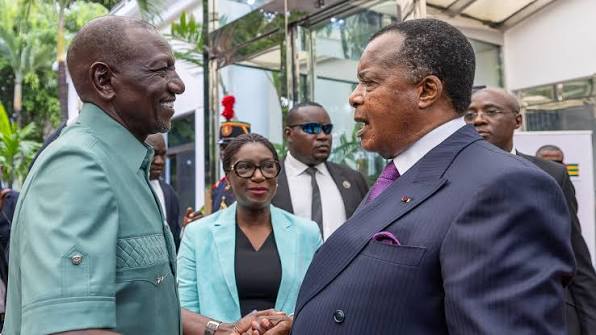
Kenyan President William Ruto and Congolese President Félix Tshisekedi reached the agreement on Sunday, Nov. 22
OYO, Republic of the Congo
Kenya and the Democratic Republic of the Congo have agreed to restore full diplomatic relations, including the return of ambassadors, after talks brokered by Congo-Brazzaville and the African Union ended a standoff that began when a Congolese rebel coalition was launched in Nairobi nearly three years ago.
Kenyan President William Ruto and Congolese President Félix Tshisekedi reached the agreement on Sunday, Nov. 22, on the sidelines of a quadripartite summit in Oyo convened by Republic of the Congo President Denis Sassou N'Guesso, with Togo's Faure Essozimna Gnassingbé, the African Union's mediator for the eastern DRC crisis, in attendance. "We committed to working towards fully restoring diplomatic relations," Ruto said, according to Kenyans.co.ke.
The deal matters because Kenya is a central economic and diplomatic partner for the DRC within the East African Community, and the rift had become entangled with the war in eastern Congo and with Kinshasa's escalating domestic political crisis. It comes as Tshisekedi faces a rebel movement now led by his predecessor, Joseph Kabila; opposition protests against a possible third term; and an Ebola outbreak that has now recorded more than 11,700 confirmed cases.
What the two leaders agreed
According to a State House statement and the DRC presidency's communiqué, as reported by Capital FM, Citizen Digital and Dawan Africa, the two governments committed to:
The leaders reaffirmed respect for national sovereignty, territorial integrity, non-interference in internal affairs and peaceful settlement of disputes, and said they were determined to put the summit's commitments into concrete action, according to The Independent (Uganda). Ruto said the countries had agreed to "open a new chapter" in their relations, Dawan Africa reported. He arrived in Oyo on Saturday after cutting short a tour of western Kenya.
The DRC will send its envoy back to Nairobi, Kenyans.co.ke reported. None of the reports gave a timeline for the exchange of ambassadors.
How the relationship broke down
The rupture dates to December 2023, when Kinshasa recalled its ambassador to Kenya after the Alliance Fleuve Congo, a political-military coalition linked to the M23 rebel movement, was launched in Nairobi, according to The Independent. The Congolese government objected to the group's activities in the Kenyan capital. Kenya has said it could not restrict political expression.
Relations deteriorated further over the following two years. The DRC briefly returned its envoy to Nairobi in mid-2024, but representation remained lopsided, Kenyans.co.ke reported. In January 2025, rioters in Kinshasa attacked and looted the Kenyan embassy, accusing Kenya of involvement in the eastern war. That same month, M23 seized Goma, the capital of North Kivu, and the two governments later disagreed over Kenya's proposed diplomatic representation in the rebel-held city, according to The Independent. In early 2025, Ruto appointed Peter Tum as Kenya's ambassador to Kinshasa, but the DRC withheld his accreditation.
Tensions deepened again in October 2025, when Nairobi hosted Congolese opposition figures, including Kabila, Dawan Africa reported, citing The EastAfrican.
The war in the east
The diplomatic thaw does not change the military picture in eastern Congo, where multiple peace tracks have so far failed to stop the fighting. In December 2025, the DRC and Rwanda signed the Washington Accords to address tensions between the two governments. On Nov. 15, 2025, the DRC government, the AFC and M23 signed the Doha Framework, and in August 2026 the parties, together with Qatar, the United States, Togo, the African Union Commission and Switzerland, agreed on a road map to advance negotiations and review implementation, according to Al Jazeera.
The rebel side has since been reorganized. In October 2026, Kabila took over the movement, renamed the Front for the Refoundation of the Nation, or FRN, which says it has succeeded the AFC and assumed its commitments, Al Jazeera and RFI reported. Kabila, 55, who ruled from 2001 to 2019, was sentenced to death in absentia just over a year ago for treason over alleged collusion with M23 and is under U.S. sanctions, according to RFI.
Fighting continues in North and South Kivu. In early November, FRN fighters advanced through Kahuzi-Biega National Park and along National Road 3, and conflict monitors said they captured several localities, including Bitale and the center of Bulambika, on Nov. 8, Al Jazeera reported. The Congolese army said it halted the advance at Bulambika and is preparing a counteroffensive. An African Union Peace and Security Council communiqué after an Oct. 26 meeting said implementation of the Washington and Doha commitments remained limited.
"One meeting follows another, and they all end up being much the same," Blaise Chasumba, a resident of Bukavu, told Al Jazeera. "We continue to lose our loved ones and our homes."
A constitutional fight in Kinshasa
Tshisekedi's domestic position has also grown more contested. Earlier this month, he enacted a law easing the rules for holding a referendum on constitutional matters, two years before the next scheduled elections, RFI reported on Nov. 12. Tshisekedi, 63, has been in power since 2019 and, under the current constitution, must step down at the end of his second five-year term in late 2028. At a news conference in May, he said he had not planned to seek a third term but added: "If people want me to have a third term, I will accept."
Kabila has criticized the government's "stubborn insistence" on changing the constitution and vowed to "put an end to tyranny by any means, including force," according to RFI. The C64 opposition platform condemned "any seizure of power by force," as well as "any change to the constitution, any third term, any postponement of the elections scheduled for 2028." Opposition demonstrations against what critics call a "constitutional coup" took place in June and September in Kinshasa and other cities. The United Nations said at least one person was killed in the June protests, and the opposition said one supporter was killed in September. The main opposition parties have rejected Tshisekedi's offer of a national dialogue.
Ebola adds urgency
The joint commitment on Ebola reflects a crisis that crosses borders. As of Nov. 20, the Bundibugyo Ebola outbreak in the DRC had reached 11,762 confirmed cases and 5,775 deaths across eight provinces, with Ituri province accounting for more than two-thirds of confirmed cases, according to an allAfrica roundup citing World Health Organization figures. Fighting in Ituri recently trapped Ebola responders and WHO staff in a hospital maternity ward for more than 24 hours, and WHO has verified more than 87 attacks on health facilities and workers in the DRC this year.
Kenya confirmed its first Ebola case on Oct. 6 in a man who had traveled from the DRC and discharged its last patient on Nov. 11, Dawan Africa reported. Health Cabinet Secretary Aden Duale said the 42-day countdown to declaring the outbreak over in Kenya ends Dec. 23.
Analysis: why Kinshasa is mending fences now
For Tshisekedi, the timing is telling. With Kabila now at the head of the eastern rebellion and the president's own constitutional ambitions drawing protests at home, restoring ties with a regional power that has hosted both the AFC launch and Kabila-linked opposition figures narrows the space available to his opponents abroad. The emphasis on "non-interference in internal affairs" in the communiqué is a clear signal of what Kinshasa expects from Nairobi in return.
For Ruto, the agreement removes a diplomatic irritant within the East African Community and reopens a large market for Kenyan business. It also positions Kenya as a partner in regional mechanisms — the ICGLR and EAC — rather than as a host of Congolese dissent. The participation of Gnassingbé, the AU mediator, suggests the continental body sees the normalization as part of a wider effort to reduce the number of external actors with competing stakes in eastern Congo.
The agreement's limits are equally clear. It contains no timeline, and it does not settle the question of Kenyan representation in rebel-held Goma. Nor can a bilateral deal between Nairobi and Kinshasa resolve a war whose main external dimension, the DRC's dispute with Rwanda, runs through separate Washington and Doha processes that the AU itself says have delivered little.
What to watch
The first concrete test will be the accreditation of ambassadors in both capitals, including whether Kinshasa now accepts Kenya's nominee. A date for the first session of the revived Joint Grand Commission would show whether the economic agenda is real. Beyond the bilateral track, observers will watch whether the FRN abandons or continues the Doha talks amid the referendum dispute, whether the Congolese army mounts its promised counteroffensive in South Kivu, and whether Kenya reaches its Dec. 23 Ebola milestone. Each will indicate whether Sunday's handshake in Oyo marks a broader de-escalation around Congo or simply one fewer front in a crowded crisis.