DESIGN
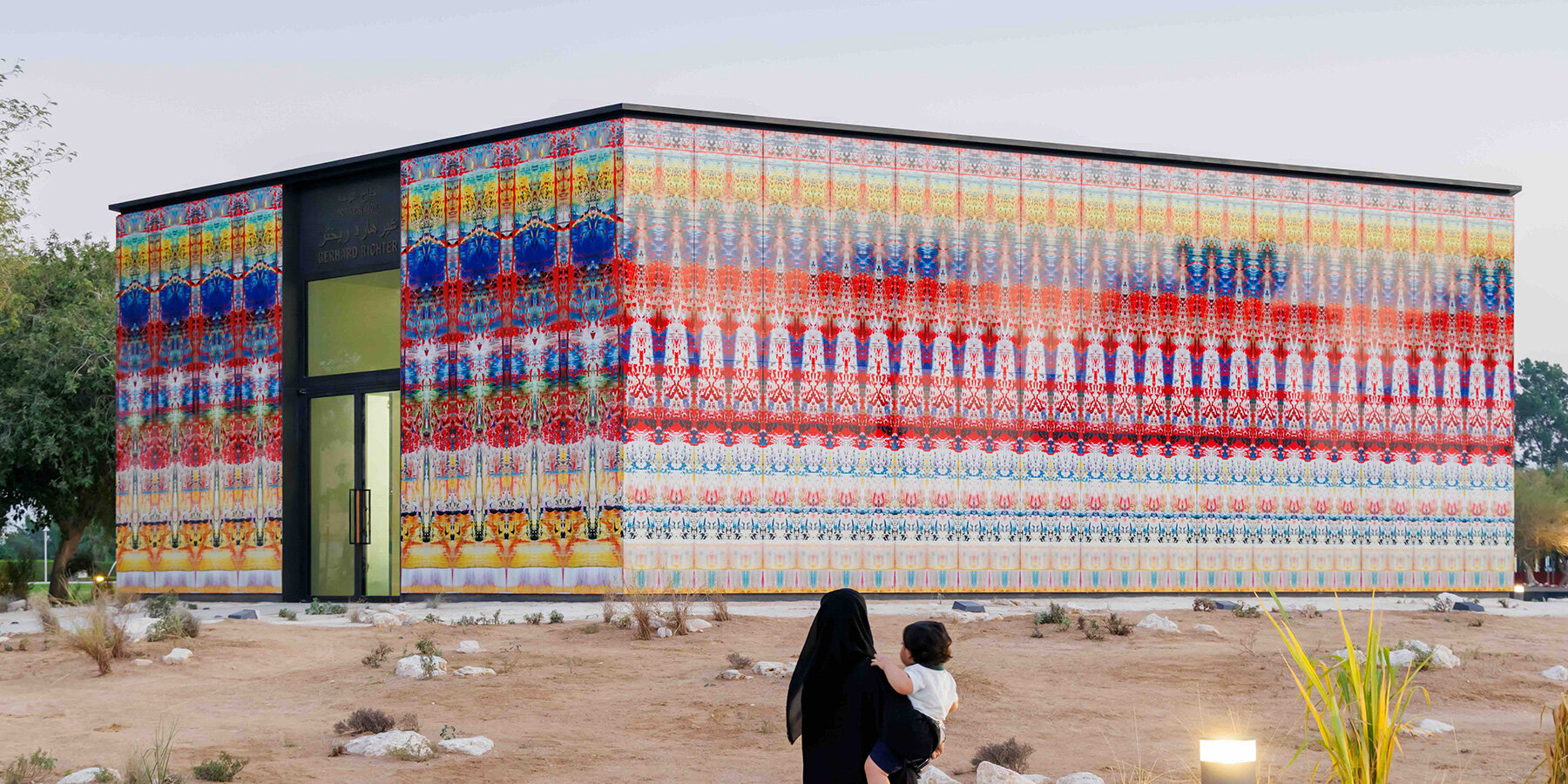
The German master has designed a permanent hexagonal pavilion beside Doha's Museum of Islamic Art, wrapped in tiles derived from his digital 'Patterns' and realized with New York's Selldorf Architects. It may be the most personal building of his career.
DOHA
Gerhard Richter has spent more than six decades asking what a painting can be: a blurred photograph, a smear of squeegeed color, a grid of chance-determined swatches. In Doha, he has posed a new question. What if a painting became a building?
Qatar Museums unveiled the Gerhard Richter Doha Pavilion on November 20, a permanent, site-specific structure in MIA Park, the public waterfront grounds outside the Museum of Islamic Art, according to Wallpaper*. The pavilion was commissioned by Qatar Museums and created in collaboration with New York-based Selldorf Architects, who, in Wallpaper*'s words, "helped bring the concept to realisation." Dezeen also featured the project this week.
A painting cut into 8,192 pieces
The building's skin tells a story that goes back to the 1990s. According to Wallpaper*, Richter took a 2010 digital image of his painting Abstract Painting (724-4) and cut it into strips, doubling the number each time until there were 8,192 of them. Each strip was mirrored and repeated, producing the horizontal bands that became his celebrated Strip works, a series he began in 2011.
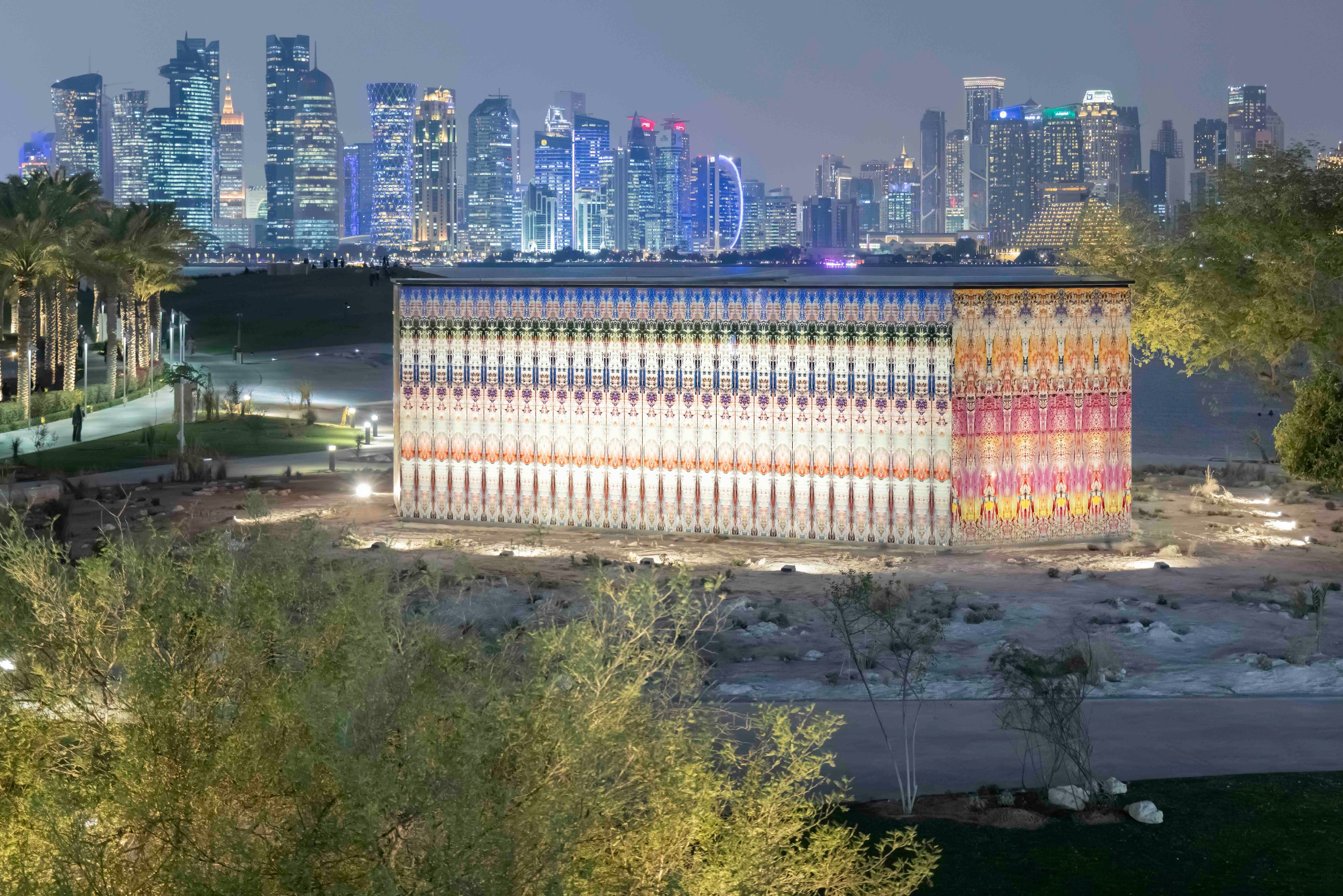
That process, known as the Patterns, is the source for the pavilion's six exterior walls, which are clad in decorative tiles. The hexagonal plan, Wallpaper* notes, reflects Richter's "analytical approach to painting." The mirrored, repeating lines also evoke the geometric patterns of Islamic art, a deliberate conversation with the museum next door.
"The Pavilion's exterior features decorative tiles based on the Patterns that first led me to the Strips," Richter said in remarks quoted by Wallpaper*.
Inside: strips, mirrors and a tower
The interior is conceived as a complete environment. Wallpaper* reports that it houses three new large-scale Strip paintings, two floor-to-ceiling mirrors and a freestanding sculpture, Strip-Tower, designed by Richter specifically for the pavilion. Outside stands a stone sculpture titled Brunnen (Well). Photographs of the building were taken by Iwan Baan, courtesy of Qatar Museums.
The mirrors are a familiar Richter device, used across his career to turn the viewer into part of the work. Combined with the dense, vibrating bands of the Strip paintings, the effect, judging by Wallpaper*'s description of a "dizzying" space, is less a gallery than an immersion chamber.
Why Doha?
Richter, now in his nineties, traces the project to a single trip. "My trip to Doha in 2013 came two years into developing my Strip paintings," he said, according to Wallpaper*, adding that "the city's architecture and history sparked an idea for a pavilion." His conclusion was unequivocal: "Doha is the right place and the only place for my Pavilion."
It is an extraordinary statement from an artist whose work hangs in the world's major museums. Richter has rarely tied his work so explicitly to a single place, and the pavilion stands as a permanent fixture rather than a touring installation.
The architect's view
For Annabelle Selldorf, whose firm has designed galleries and museums around the world, the project was an exercise in translation rather than authorship. "I am grateful for the welcome that Gerhard Richter extended to me," she said in comments quoted by Wallpaper*, explaining that "my studio made manifest the work that had existed in his mind."
Selldorf described the pavilion as "the profound culmination of many years of his research into abstraction," with "intensely physical patterns that invite you to immerse yourself in their endlessness." She added: "The more I look at them, the more fascinating they become to me as an architectural space to experience."
That humility is notable. Many artist-architect collaborations become a contest of egos. Here, the architect positions her role as giving form to an idea that was already complete, which, for an artist as exacting as Richter, may be precisely what was needed.
Part of a bigger cultural moment
The pavilion opens as part of Qatar Creates Fall/Winter 2026-27 and coincides with the inaugural Rubaiya Qatar 2026, an international visual arts quadrennial running from November 21, 2026, to April 30, 2027, according to Wallpaper*. Qatar has spent years building a reputation as a cultural destination through landmark architecture, and a permanent Richter work beside I.M. Pei's Museum of Islamic Art adds another name to that roster.
Wallpaper* also situates the pavilion alongside Richter's other large-scale sculptural work, including a Strip-Tower installed at Serpentine South in London. But Doha is the first time the strip concept has been extended into a full building that visitors can circle and enter.
What this means for you
If you are travelling to the Gulf this winter, the pavilion is now one of the region's essential art stops, and its setting in MIA Park means it can be paired with a visit to the Museum of Islamic Art in a single afternoon. Rubaiya Qatar runs through April, making the coming months an ideal window.
For design lovers at home, the pavilion is a lesson in how pattern can do architectural work. Its walls show how a single repeating motif, scaled and mirrored, can create rhythm and depth, an idea that translates readily to tiles, textiles and wallcoverings in a home.
The bottom line
The Gerhard Richter Doha Pavilion is a building that behaves like a painting and a painting that behaves like a building. Born from a 2013 visit and a digital image sliced 8,192 times, it is a late-career statement from one of art's great experimenters, and a reminder that abstraction, given walls, can still make you lose your bearings.
Published By | Features Editor