Written By | International News Agencies
Information Minister Abdifatah Kasim Mohamud announced the measures after a cabinet meeting chaired by Prime Minister Hamza Abdi Barre, according to the Somali Guardian.
MOGADISHU, Somalia
Somalia's federal government has ordered the United Arab Emirates' ambassador to leave the country within 72 hours and recalled its own envoy from Abu Dhabi, accusing the Gulf state of an "open invasion" of Somali sovereignty. It is the sharpest rupture yet in a relationship that has been unraveling since January. The decision, taken at a Council of Ministers meeting on Thursday, Nov. 19, comes as Mogadishu faces armed conflict in the country's south-west, defiance from several federal member states and a Supreme Court ruling that the president's own mandate has expired.
The confrontation matters beyond Somalia's borders. The UAE is one of the most influential foreign powers in the Horn of Africa. It runs or backs ports along the Gulf of Aden and the Indian Ocean, and for years it has trained and paid Somali security forces. By expelling its ambassador, the federal government is staking its claim to sole authority over foreign relations at the very moment its domestic legitimacy is being challenged in court and on the battlefield.
The decision
Information Minister Abdifatah Kasim Mohamud announced the measures after a cabinet meeting chaired by Prime Minister Hamza Abdi Barre, according to the Somali Guardian. The ambassador, identified by the outlet as Ahmed Jumaa Mohamed Hathboor Alremeithi, was given 72 hours to depart. Somalia's ambassador to the UAE, Hussein Abdi Halane, was summoned home for consultations. The Somali Guardian noted that the order stops short of formally severing diplomatic relations.
"Measures will be taken against anyone who cooperates with UAE in the invasion against Somalia," Mohamud said in a broadcast on the state news agency, Al Jazeera reported. "All Somalis are urged to defend their country and unite against the open invasion of the UAE."
According to Dawan Africa, the cabinet called the UAE's conduct "open aggression" and a serious violation of international law. It pledged to defend Somalia's territorial integrity and sovereignty "through every possible means." It also instructed the Ministry of Foreign Affairs to share its report on the alleged interference with foreign governments and international organizations.
The UAE's foreign ministry condemned the move. Xinhua reported that it denounced an "escalatory and hostile approach" and said bilateral relations should be guided by mutual interests and kept free of internal conflicts. Al Jazeera reported that Abu Dhabi warned the decision would harm relations between the two countries.
The road to rupture
The expulsion followed a televised address on Tuesday, Nov. 17, in which President Hassan Sheikh Mohamud accused the UAE of backing regional administrations that oppose the federal government. He said Abu Dhabi had signed agreements on the ports of Berbera in Somaliland, Bosaso in Puntland and Kismayo in Jubaland directly with those administrations rather than with Mogadishu. He also said the Emiratis had helped establish military bases and forces outside Somalia's national command structure.
"The UAE wants to bring to Somalia and Sudan the same divisions it has left behind in Libya and Yemen," Mohamud said, according to Kenya's The Standard. Xinhua reported that he also said Mogadishu remained open to relations "based on equality and mutual respect."
Abu Dhabi's response was personal. In a post on X reported by Gulf News on Nov. 18, Anwar Gargash, a senior diplomatic adviser to the UAE president, wrote that "the outgoing Somali president's attack on the UAE reflects the fluctuations in his positions and policies." He added: "It is regrettable that internal power struggles in Somalia are being dragged into regional disputes." Calling Mohamud "outgoing" was deliberate, as the dispute over his mandate shows.
The current crisis has its roots in events from December and January. Israel recognized Somaliland, the breakaway northern region that declared independence in 1991, in December 2025, and many Somalis believe the UAE helped bring that about. The UAE has not commented on that allegation, according to Al Jazeera. Then, on Jan. 8, Somali officials said Aidarous al-Zubaidi, leader of Yemen's UAE-backed Southern Transitional Council, had flown from Berbera to Mogadishu on a UAE-registered cargo plane whose manifest did not list his name. Foreign Minister Ali Omar called the episode "the last straw." On Jan. 12, the Council of Ministers cancelled all agreements with the UAE, including port operations, security cooperation and defense pacts. Somalia has since closed its airspace to Emirati military and cargo aircraft, the Somali Guardian reported.
Fighting in the south-west
On Thursday, Prime Minister Barre went further than the cabinet statement. Speaking at a ceremony in Mogadishu honoring the Waaberi arts troupe, he blamed the UAE directly for deaths in fighting in the Bay, Bakool and Lower Shabelle regions, Dawan Africa reported. "Every single person we lose in Bay, Bakool and Lower Shabelle, they are responsible," he said.
Barre alleged that after Somalia withdrew from its agreements with the UAE, Emirati officials met Somali opposition figures in Dubai and told them funding would go only to those who took up arms. He said some opposition politicians refused, replying that "our dispute is political. We will not become warlords." He also accused the UAE of supplying money, ammunition and drones, and of bribing neighboring governments. He compared the situation with Sudan, claiming that UAE-armed militias had killed 6,000 people in El Fasher in three hours. Dawan Africa presented these as the prime minister's allegations and did not independently verify them. The UAE has long denied interfering in Somalia's internal affairs and describes its activities as contributing to stability and development.
The fighting Barre referred to is real and severe. Since mid-August, federal forces and the South West State administration have been fighting forces loyal to former regional president Abdiaziz Hassan Mohamed Laftagareen in and around Baidoa, the state's seat. The administration is now led by Sheikh Aden Mohamed Nur, known as Aden Madobe, who formally took office on June 11, 2026, after Laftagareen's removal amid a dispute with Mogadishu. Citing the International Committee of the Red Cross, Dawan Africa reported that the fighting in and around Baidoa has displaced more than 18,000 people. Somali Red Crescent volunteers have taken 527 wounded people to hospitals.
A president whose mandate is in question
The diplomatic offensive is unfolding alongside a constitutional crisis at home. On Nov. 5, the five-member Constitutional Division of Somalia's Supreme Court ruled on a petition brought by former President Sharif Sheikh Ahmed, according to Horn Diplomat's reporting carried by AllAfrica. The court rejected Ahmed's challenge to the procedure used to amend the constitution, finding he lacked standing. It upheld his challenge to applying longer terms to institutions already in office.
In early March, parliament approved amendments that lengthened presidential and legislative terms from four years to five. Reuters, as carried by CNBC Africa, reported that 222 of 329 lawmakers approved the change by acclamation, while opposition parties and regional leaders boycotted the vote. The court found that the amendments did not explicitly apply the new terms to sitting officeholders, so the original four-year mandates still governed. It said Mohamud's mandate expired on May 15, 2026, and that of both houses of parliament on April 14, 2026. It gave political stakeholders 30 days to agree on an electoral framework, ordered elections within 90 days, and limited the federal government to routine caretaker duties.
The ruling came a day after the presidency announced the dismissal of Chief Justice Baashe Yusuf Ahmed on Nov. 4 and appointed former Chief Justice Ibrahim Idle Suleiman in his place. In a separate statement, the court said the announcement "does not cite any legal provision" and was aimed at obstructing "the administration of justice." The presidency said the change followed complaints from judges and legal professionals. Mohamud maintains that the March amendments gave him an additional year, with parliamentary and presidential elections scheduled for April and May 2027.
Analysis: sovereignty as a domestic argument
The sequence of events explains why Mogadishu chose this week to escalate. The federal government's quarrel with the UAE is, at bottom, a quarrel with Somalia's federal member states. Omar Mahmood of the International Crisis Group told Al Jazeera that coastal ports are major sources of income and that regional administrations "maintain independent revenue streams," which gives them more autonomy from Mogadishu. Because the federal government sees itself as Somalia's internationally recognized authority, it treats any foreign deal signed directly with a region, and any Emirati presence tied to such a deal, as a violation of territorial sovereignty.
The regions do not accept that view. Somaliland's Foreign Ministry said this week that its diplomatic, economic and strategic agreements do not require Mogadishu's approval, AllAfrica reported. It argued that its 1960 union with Somalia was never ratified by a mutual legal act. Puntland and Jubaland have also rejected Mogadishu's authority over arrangements on their territory, and both have challenged the January cancellation.
Expelling the ambassador casts the government's domestic critics as potential collaborators with a foreign "invasion." It also turns the dispute over who governs Somalia, and for how long, into a contest over national loyalty. Gargash's description of Mohamud as "outgoing" shows that Abu Dhabi sees the opening this creates. For the UAE, the Supreme Court ruling offers a ready argument that it is dealing with a government whose authority is contested.
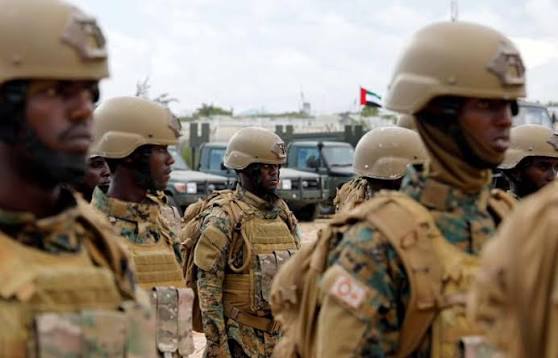
There are practical risks as well. According to senior Somali sources cited by Al Jazeera and the Somali Guardian, the UAE still pays salaries and provides logistics for about 3,400 Somali military police and special forces personnel in and around Mogadishu. Neither outlet independently verified that figure. The UAE trained hundreds of Somali troops between 2014 and 2018. A full break could leave a funding gap in units that matter for the capital's security while the army is still fighting al-Shabab.
What to watch
The first test is whether the ambassador's departure is followed by wider measures against Emirati personnel, commercial contracts or security arrangements, or whether the recall of Somalia's envoy "for consultations" leaves room for de-escalation. The second is whether Somaliland, Puntland and Jubaland change course. All three have said they will keep their ties with Abu Dhabi.
At home, the Supreme Court's 30-day window for agreeing an electoral framework runs out in early December. How the government answers that deadline will shape whether foreign partners keep treating Mohamud as Somalia's legitimate interlocutor. The rival Gulf, Turkish and Egyptian interests in the region will also be watching Mogadishu's next move. The fighting around Baidoa, meanwhile, will show whether the government's sovereignty campaign can be matched by authority on the ground.