Written By | Fashion and Design Desk
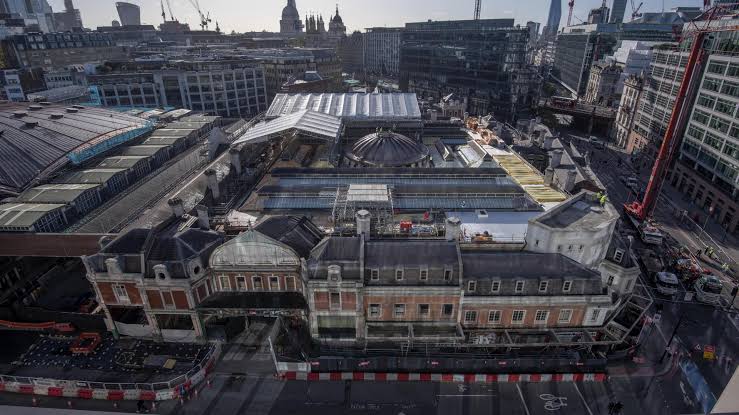
After a decade of work, Sir Horace Jones's Victorian General Market becomes a free museum of the city, complete with Roman streets, iron columns and a window onto passing trains
DESIGN
LONDON
For more than a century, Smithfield's General Market fed London. For the past three decades, it mostly sat empty, a grand Victorian shell on the edge of the City slowly falling into disrepair. On Saturday, November 28, it gets a new purpose, and arguably its most ambitious one yet.
London Museum, the institution formerly known as the Museum of London, will open its new home inside the restored market building, marking the museum's 50th anniversary. Design coverage this week, led by designboom and Dezeen, has given the public its first detailed look inside the transformation, a project the museum describes as costing £437 million and involving more than 70 trades over roughly ten years.
A Victorian landmark, rescued
The General Market was designed by Sir Horace Jones, the architect behind Tower Bridge and Leadenhall Market, and opened in 1883. It operated for more than a century before closing in the 1990s. The museum's own move was prompted by the need to leave its former site at London Wall, which closed in 2022.
The new design is a collaboration between Stanton Williams as lead architect, Asif Khan Studio as collaborating architect and Julian Harrap Architects as conservation architect. Their approach, as designboom describes it, has been to celebrate the building's original fabric rather than hide it. Original market signs, heritage shopfronts and decorative ironwork have been retained, while the wrought-iron Phoenix columns that hold up the ceiling remain on show. The building's dome has been restored, and Victorian vaults rediscovered during the works have been brought back into use.
The craftsmanship involved reads like a roll call of heritage trades: master stonemasons, Welsh blacksmiths and heritage coppersmiths were among those brought in to bring the market back to life.
Three times, one museum
The museum is organized around a simple and clever idea, with each space named for a different relationship to time.
Real Time occupies the former covered street of West Poultry Avenue, now the museum's main entrance. It is the space where the city's present day flows in, open and street-like.
Our Time sits in the Linbury Hall, the former trading floor. According to the museum, it houses 13 large "anchor" displays, along with a restaurant, a shop and a show space.
Past Time takes visitors underground to Roman street level, into galleries that trace 2,000 years of the city's history. One of the building's signature features is here too: a six-metre viewing window looking directly onto live Thameslink trains running between Farringdon and City Thameslink stations, a reminder that this site has always been about movement and trade.
Around the perimeter, a parade of 44 historic shopfronts stretching some 250 metres has been given over to independent organizations, including a pub and A New Direction, a children's arts charity.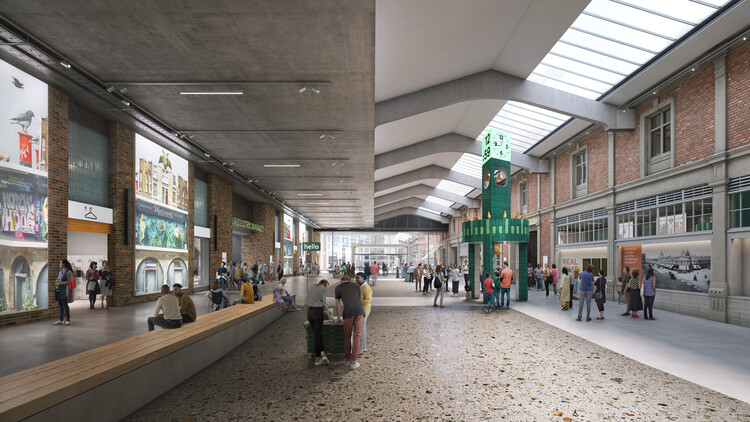
What's on display
London Museum's collection runs to around 7 million objects spanning 450,000 years, and the opening displays mix the monumental with the personal. Highlights named by the museum include the Lord Mayor's Coach, the Whitechapel Fatberg, Banksy's Piranhas, the Selfridges lift, the Cheapside Hoard in the Goldsmiths' Gallery, Emmeline Pankhurst's hunger strike medal, Anna Pavlova's Dying Swan dress, Queen Victoria's mourning dress, Charles Dickens' chair, Tom Daley's 2012 Olympic diving trunks and Paul Simonon's smashed Fender Precision Bass. The vest Charles I is said to have worn at his execution will be shown for six months. Crucially, the permanent galleries are free to visit, with free general admission tickets available to book.
A building made with the city
The museum says more than 100,000 people contributed to shaping the project. The project is a partnership between the City of London Corporation and the Mayor of London, supported by a loan from the Mayor's Green Finance Fund and philanthropic backing including Bloomberg Philanthropies, the Goldsmiths' Foundation, The Linbury Trust and The National Lottery Heritage Fund. The scheme is targeting a BREEAM Outstanding sustainability rating, and designboom reports an ambition to welcome around two million visitors a year.
Announcing the opening date earlier this year, director Sharon Ament said the team was "counting down the days to welcome our first visitors," adding, "I hope we make Londoners proud!" Christopher Hayward, policy chairman of the City of London Corporation, called it "a landmark moment for the Square Mile," while Mayor Sadiq Khan predicted that "London Museum will attract millions of visitors and Londoners."
What this means for you
If you are in London, or planning a trip, this is the cultural opening of the season. Book a free general admission ticket in advance, as demand in the opening weeks is likely to be high. The museum's programme goes well beyond the galleries: a Tuesday Tea Club and Shared Late Nights on Fridays and Saturdays start this month, with a monthly Dinner Club from January and a House Party on the first Saturday of each month from February, which Time Out reports is in partnership with the nightclub Fabric. Families can look out for Showspace on Sundays and Playdates for children aged 7 and up on Saturdays from January.
Food lovers should note the inaugural programme, London Tastes, guest-edited by writers Ruby Tandoh and Jonathan Nunn and running from November 2026 to August 2027, a fitting theme for a building that spent a century as a market.
The bottom line
London Museum at Smithfield is a lesson in how to treat a historic building: keep the iron, keep the signs, keep the shopfronts, and give it back to the public. With the neighboring Poultry Market scheduled to open in 2028, the project is not finished yet. But on Saturday one of the City's great Victorian buildings will be busy again, and this time everyone is invited in for free.