World Politics
Overview
Donald Trump arrived in the southern Chinese city of Shenzhen on Wednesday, November 18, for the Asia-Pacific Economic Cooperation (APEC) summit. He was met at the airport by Xi Jinping in person, a gesture with almost no precedent in Chinese diplomacy. Video of the arrival showed the US president returning a salute on a red carpet lined with flag-waving crowds before he shook hands with Xi and embraced him, and the two men walked together to their motorcades. The BBC's Laura Bicker, in analysis quoted by Danish outlet The Copenhagen Post, wrote that "this is not merely an airport welcome," noting that Xi is believed to be the first Chinese president to greet a visiting leader at the airport.
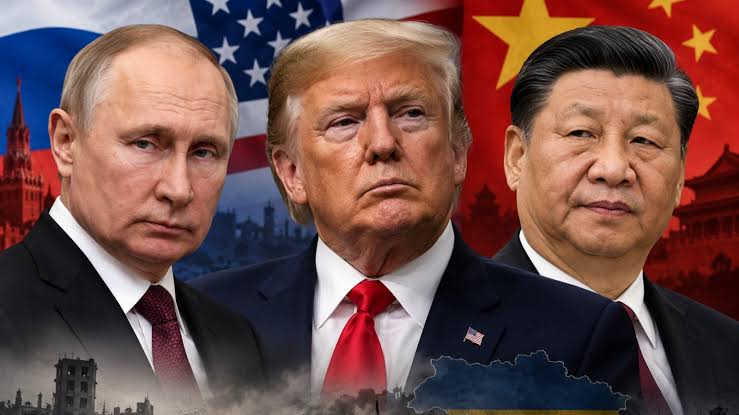
The welcome set the stage for what both Washington and Moscow describe as the first-ever leaders' meeting between the United States, China and Russia, scheduled for Thursday, November 19, on the sidelines of APEC. Hours before Trump touched down, Xi held more than two hours of talks with Vladimir Putin in the same city, a meeting the Russian news agency TASS described in detail and in which both leaders stressed the strength of their partnership. Whatever comes out of Thursday's session, the choreography of the past 24 hours has already told the world a great deal about how each of the three powers wants to be seen.
Background: How the Shenzhen Trilateral Came Together
The idea of a three-way meeting was floated by the Kremlin as early as September, when Russian officials said a Trump-Xi-Putin encounter at the November APEC forum was possible. It was formally confirmed by the White House on November 13 and by Kremlin spokesman Dmitry Peskov the following day. According to a report cited by South Korea's SBS, Putin proposed the trilateral to Trump last month, reportedly in exchange for US agreement to import Russian diesel, a deal that critics such as the Atlantic Council's John Herbst cite as evidence of Washington accommodating Moscow.
The White House has framed the summit primarily around nuclear arms control. The last US-Russia strategic arms treaty, New START, expired in February 2026, leaving the world's two largest nuclear arsenals without binding limits for the first time in decades. Trump has repeatedly said he wants a deal that also includes China, whose arsenal is growing quickly. Beijing has long insisted that the United States and Russia must first cut their far larger stockpiles before China joins any talks.
This will be Trump's third face-to-face meeting with Xi this year. He visited China in May, and Xi made a state visit to Washington in September, when Trump personally greeted him at Joint Base Andrews and the two sides extended a tariff truce. Trump last met Putin in Alaska in August 2025, talks that failed to produce the Ukraine ceasefire Washington had sought.

Key Developments: The Road From Manila
Trump flew to Shenzhen from Manila, where he attended the 49th ASEAN Summit and held a state visit with Philippine President Ferdinand Marcos Jr. In Manila he also met the leaders of Australia, India and Japan in a Quad format for the first time in his second term, calling the relationship "very special," and announced an $85 million investment in AI software. His visit drew protests: about 2,000 demonstrators gathered with banners reading "Trump out now" and "Reject Pax Silica," a reference to a US-backed AI hub initiative, according to AFP reporting carried by the Kyiv Post.
The trip comes two weeks after Republicans suffered heavy losses in the US midterm elections, a backdrop that Israeli outlet Ynet described as adding domestic pressure on the president as he heads into one of the most closely watched diplomatic encounters of his term.
Before leaving Washington, Trump said he might also meet North Korean leader Kim Jong Un while in China. After arriving in Asia, he said Kim "would like to" come but added, "we'll see what happens." Secretary of State Marco Rubio did not confirm any such meeting, saying only that "if we have a problem with North Korea, the only way we're ever going to solve it is if we engage with them." Peskov said Putin, too, could meet Kim if the North Korean leader attended. South Korea's JoongAng Daily reported that no talks with Pyongyang were formally planned.
The Xi-Putin Meeting
Xi and Putin met in Shenzhen on Wednesday in what AFP counted as their fifth meeting of the year, including one by video link; Putin, in remarks reported by SBS, referred to "four summits this year," a difference that likely reflects whether the video call is counted. TASS reported that the talks ran for more than two hours. Russian officials said the leaders would first discuss energy and finance, and then, in a smaller format, foreign policy issues including Ukraine and North Korea.
Xi described the relationship as "as stable as a mountain, unfazed by storms," saying it had "provided greater stability and certainty to a rapidly changing world," and called for both sides to "deepen all-around cooperation." Putin said bilateral trade had "once again reached a record high" and that Russia wished to "jointly advance the process of world multipolarity" and build "a fairer and more rational global governance system." He also argued that Western sanctions had failed to isolate Russia, and said that "at a time when military-political risks are on the rise, what is desperately needed is unity rather than division."
There was no sign of a breakthrough on the long-stalled Power of Siberia 2 gas pipeline, which SBS noted remains unresolved over pricing. China's official line was that the three leaders would hold "in-depth exchanges on safeguarding world peace and promoting strategic stability in major-power relations."
Putin's foreign policy aide Yuri Ushakov told TASS that the three leaders "have a lot to discuss given the turbulent situation in the world," that "the number of participants will definitely be quite small," and that there would be "no large delegations." He added that Putin and Trump would have "several opportunities to converse" in Shenzhen, and that "when the leaders meet face to face, believe me, they will have a full-fledged conversation."
The Agenda: Nuclear Weapons, Iran and an Unresolved Question on Ukraine
Three subjects dominate the expected agenda. The first is nuclear arms control. Analysts at the Atlantic Council were skeptical of a substantive outcome. Alyxandra Marine noted that China rejects trilateral limits by pointing to the gap between its stockpile and those of the United States and Russia, despite projections that Beijing could field more than 1,000 warheads by 2030, while Russia links any participation to the inclusion of British and French arsenals and to US concessions on Ukraine. Modest steps, such as a missile-launch notification arrangement or a joint statement against nuclear testing, are possible but, in her assessment, unlikely.
The second is the US-Iran war and the closure of the Strait of Hormuz. A senior US official said Trump intends to raise Iran in Shenzhen, and Atlantic Council analyst Andrew Peek argued that Xi shares an interest in reopening Hormuz and preventing an Iranian nuclear weapon. The issue is pressing: Iran fired drones at a US radar installation at Bahrain's Sheikh Isa base in recent days, according to Reuters, and Qatar has warned that Gulf escalation poses a "grave danger" while announcing new talks with Tehran.
The third, and most contested, is Ukraine. Washington had signaled that Ukraine would not be formally on the agenda, but Trump later said it would be discussed. The ambiguity has alarmed Kyiv and its European backers, who fear a deal struck over their heads. Commentators have compared the gathering to the 1945 Yalta conference; Peskov has dismissed that framing. Ukrainian President Volodymyr Zelensky, speaking to allies in the Ramstein format, nevertheless called the summit potentially "highly useful." Separately, US envoys Steve Witkoff and Jared Kushner are due to meet Ukrainian and European officials in Berlin on Thursday on security guarantees and reconstruction, according to Axios and Reuters, while Ushakov said Moscow has not agreed to European participation in the next round of peace talks.
The summit also unfolds just a day after Ukraine brought down a span of the Kerch (Crimean) Bridge. The Kremlin has said the bridge will be rebuilt "better than before."
Trade and Technology in the Background
Xi used his APEC opening remarks to present Beijing as a defender of open trade, urging international cooperation on artificial intelligence and pledging to start "by lowering tariffs, expanding access and exploring regulations and management standards." Chinese Premier Li Qiang earlier criticized a "countercurrent of unilateralism and protectionism." Brazil's Luiz Inácio Lula da Silva and Canada's Mark Carney both stressed reducing dependence on the US market, and Xi and Carney agreed on further tariff cuts, according to AP.
Washington, for its part, announced new licensing requirements on exports of advanced AI chips to Singapore, Malaysia, Thailand and Indonesia, citing a "higher-than-normal risk of diversion," and the Commerce Department issued a rule requiring overseas data centers to obtain licenses before supplying significant computing power to firms headquartered in China, Russia, Iran and other high-risk countries. Trump also said the US would catch up with China in rare-earth production "within 10 months." The scandal surrounding former Nvidia chief executive Jensen Huang hovers over the visit, though White House officials said they do not expect it to figure in talks with China.
Reactions and Anxieties
For US allies in Asia, the summit raises fears of both abandonment and entrapment. Atlantic Council analyst Rick Hoehne noted that Taiwan worries about suspended arms sales, Japan about Russian-Chinese alignment, South Korea about North Korea's ties to Moscow, and the Philippines about the South China Sea. Those concerns were underlined this week when Japan scrambled fighter jets and lodged a protest after two suspected Russian aircraft violated its airspace, and South Korea and Taiwan also reacted to Russian aircraft in their air defense zones, the BBC reported.
In Europe, analyst Daniel Fried said leaders will watch for any arrangement on Ukraine made without them and will be uneasy at Putin being treated as an equal while Russia escalates hybrid attacks on European states. Melanie Hart of the Atlantic Council argued that Xi is primarily after optics: a show of convening power ahead of the 2027 Communist Party Congress, where he could seek a fourth term. China, she said, wants "show, not substance."
What's Next
Thursday's sequence, according to Ynet and CBS, begins with a Trump-Xi bilateral followed by the trilateral session, while Ushakov said the leaders will meet at the APEC plenary "and immediately afterward." A Trump-Putin one-on-one remains possible but was not confirmed, and a Kim Jong Un appearance remains speculative. Most analysts expect symbolism over substance: a joint photograph, perhaps a statement of intent on strategic stability, and competing readouts. The real test will come afterward, in whether Washington consults allies in Kyiv, Tokyo, Seoul and Brussels, and in whether any Shenzhen understanding on Iran, nuclear risk or Ukraine survives contact with the wars still raging in the Gulf and on the Dnipro.
Published By | News Editor