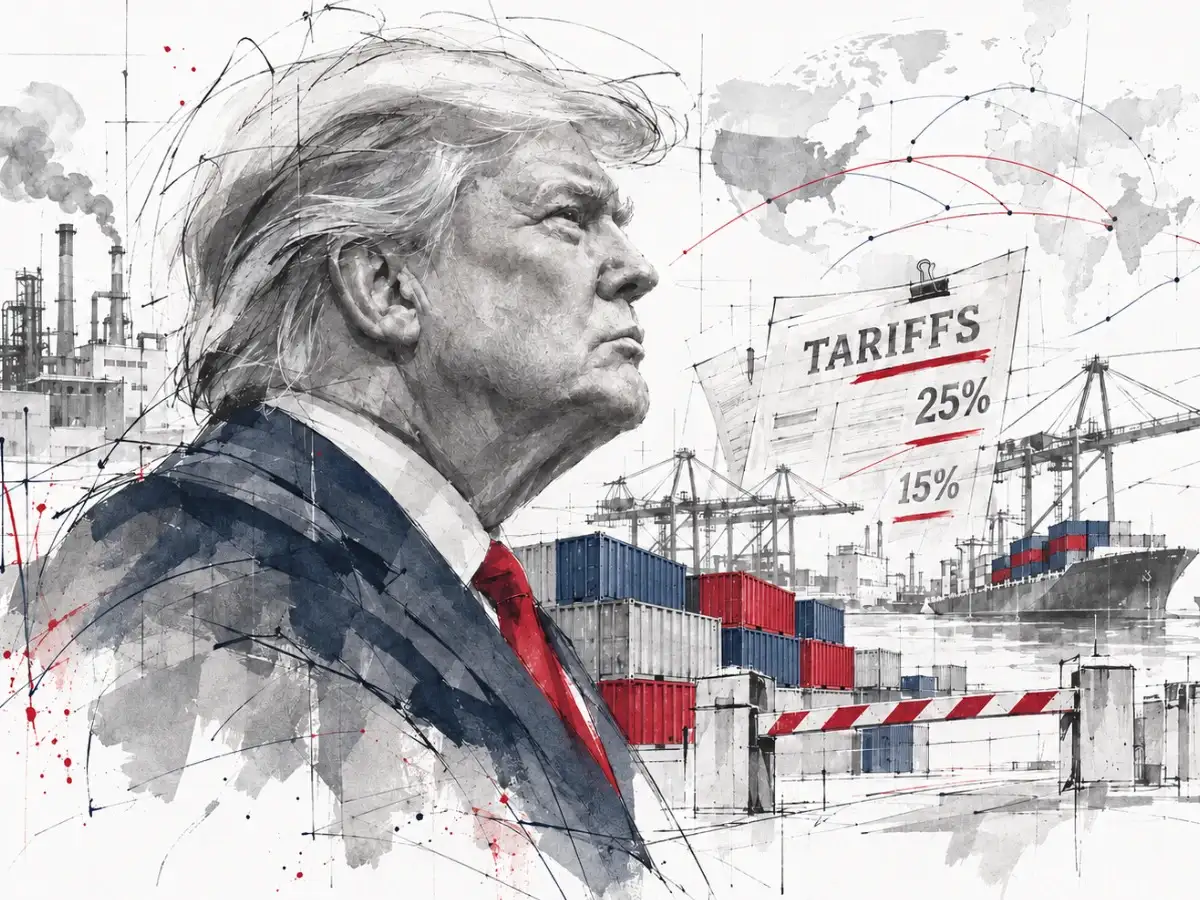
Using Section 301 after the Supreme Court struck down its emergency tariffs, the Trump administration has proposed duties of up to 35 percent on China, the European Union, Japan, India and ten other economies, setting up a winter of hearings, bargaining and diplomatic pushback.
What Was Announced
On the eve of the Thanksgiving holiday, the Trump administration unveiled its most sweeping trade action since the Supreme Court dismantled its emergency tariff program earlier this year. On Wednesday, November 25, US Trade Representative Jamieson Greer announced affirmative determinations in 14 investigations under Section 301 of the Trade Act of 1974, concluding that the industrial policies of 14 trading partners have produced "structural excess capacity" in manufacturing that burdens American commerce. Alongside those findings, his office proposed new country-specific tariffs that would cover the large majority of goods the United States imports from the targeted economies.
The list reads like a directory of America's most important commercial relationships: China, the European Union, Japan, South Korea, Taiwan, India, Switzerland, Singapore, Vietnam, Indonesia, Malaysia, Thailand, Cambodia and Bangladesh. Twelve of the 14 are in Asia. Two further economies that were under investigation, Mexico and Norway, have not yet received determinations, according to the USTR's announcement.
Nothing takes effect immediately. The proposals now enter a formal comment process, and the administration has signalled that final action is unlikely before early 2027. But the scale of the move, and the timing just days after President Donald Trump's summit diplomacy with Chinese leader Xi Jinping, has made it the dominant economic-policy story of the week in Washington and in capitals across Europe and Asia.
The Proposed Rates
According to the USTR press release, the proposed rates vary sharply by country and are framed as ceilings, generally calculated "net of" duties already in place. China faces a tariff of up to 20 percent on most covered goods, calculated net of the forced-labor Section 301 duties imposed earlier in 2026, with a lower rate of up to 10 percent on goods listed in one annex and an exemption for a separate list of products. The European Union faces a flat 15 percent, net of most-favored-nation duties and existing Section 301 tariffs. Japan, South Korea, Switzerland and Taiwan each face up to 15 percent.
The steepest proposed rate is for Vietnam, at up to 35 percent, which USTR says could fall to 20 percent if Hanoi reaches a responsive agreement. India faces up to 25 percent, adjustable to 17 percent with an agreement. Singapore faces up to 20 percent, reducible to 10 percent if it concludes a reciprocal trade agreement. Indonesia, Malaysia, Thailand, Cambodia and Bangladesh each face up to 18 percent.
The law firm Baker McKenzie, in an analysis of the accompanying Federal Register notices, reported that 11 of the economies also face higher "alternative" rates if consultations are judged unsatisfactory, including up to 40 percent for China, up to 25 percent for South Korea and Taiwan, and up to 20 percent for the EU and Japan. TIME likewise reported that China's rate could rise to 40 percent if Beijing fails to honor last year's trade truce and the EU's to 20 percent if existing agreements are not respected. These alternative figures do not appear in the USTR press release itself, so they should be read as notice-level details reported by secondary sources.
Coverage has also varied. TIME described rates for the smaller Asian economies as ranging from 15 percent to upwards of 25 percent, while a New York Post report syndicated by Yahoo Finance said levies on most partners were expected in a 10 to 18 percent range. The USTR figures cited above are the most authoritative available. Baker McKenzie further noted that for 13 of the 14 economies, goods already covered by Section 232 national-security tariffs, such as steel, aluminum, copper, autos and parts, semiconductors and certain pharmaceuticals, are excluded, and that the notices do not spell out precisely how the "net of" calculations will work or how the new duties will stack on older ones.
Background: Section 301 After the Supreme Court
The legal vehicle matters as much as the rates. In February 2026 the Supreme Court struck down the tariffs the administration had imposed under the International Emergency Economic Powers Act, including the so-called Liberation Day duties and the 2025 reciprocal tariffs, according to TIME. That ruling left the White House searching for authorities with firmer statutory footing. In March, the USTR opened Section 301 investigations into structural excess capacity, a statute that allows the executive branch to investigate foreign practices it deems unreasonable or burdensome to US commerce and to impose remedies through executive action once findings are made.
Section 301 comes with procedural requirements that IEEPA did not. Kathleen Claussen, a trade law professor at Georgetown cited by TIME, noted that the United States must request consultations with affected governments and that the USTR must respond to public comments in its final determination. She described Section 301 as "a very powerful tool, empowering the executive branch to act against other countries," and suggested the proposal may also serve as leverage to extract trade deals. By her count, the second Trump administration has now launched seven Section 301 investigations, compared with three under President Joe Biden.
The new duties also sit uneasily alongside the bilateral frameworks Washington negotiated over the past year and a half. The EU agreed in 2025 to a framework under which most of its exports would face a 15 percent ceiling, and Japan, South Korea, Switzerland and Taiwan reached their own arrangements. USTR says each proposed rate "accounts for" existing Section 301 and 232 duties, ongoing consultations and commitments under those frameworks, a phrasing intended to signal continuity even as it creates a new legal basis for the tariffs that replaced the invalidated IEEPA levies.
The action does not stand alone. TIME noted that the administration has imposed 50 percent tariffs on roughly $20 billion of Canadian goods after talks broke down, prompting Canadian retaliation, and has proposed separate tariff increases on Brazil targeting sugar and aircraft.
The Administration's Case
Greer framed the decision as a response to decades of state-directed industrial policy abroad. "For decades, many of our trading partners have adopted industrial strategies built on targeting manufacturing," he said in the USTR statement, arguing that repeated statements from the G7, the G20 and the World Trade Organization "have not resulted in change" and that the president was therefore proposing to act to "level the playing field for American workers." The underlying report argues that these practices flood world markets with low-cost goods and erode US manufacturing.
In an interview with CNBC quoted by TIME, Greer sought to play down the shock value of the announcement. "We've talked to our trading partners about this—they know what we're proposing," he said, adding that "a lot of this is baked in." He also said he did not expect any of the tariffs to take effect earlier than a couple of months from now.
Reactions at Home and Abroad
Beijing rejected the premise of the investigation outright. Chinese Foreign Ministry spokesperson Guo Jiakun said, as quoted by TIME, that "the so-called 'overcapacity' is a false issue, and China opposes using it as an excuse for political manipulation." The announcement came only days after the high-profile meetings between Trump and Xi in Shenzhen, after which China extended its suspension of some critical-mineral export restrictions on the United States into January. The two leaders are expected to meet again at the G20 summit in Miami in December, and Baker McKenzie noted that the current US-China trade truce is due to expire on January 10, 2027.
Brussels was equally firm. A European Commission spokesperson told TIME: "We strongly reject the premise that Europe is a source of structural overcapacity." The Commission said it regretted "the lack of joint action" on the problem of global overcapacity and expected any US measure to respect the agreed 15 percent ceiling in full, including when combined with existing duties. That point is likely to become the central friction in transatlantic talks, since the EU regards the 15 percent figure as an all-inclusive cap, while the US notices leave open how stacking will be calculated. The announcement also coincides with a two-day summit of EU leaders that opens in Brussels on November 26.
Public reactions from Tokyo, Seoul, New Delhi, Hanoi and the Southeast Asian capitals were not reported in the sources reviewed for this article by the time of writing, although CNBC reported on November 26 that the threats were piling pressure on partners to finalize trade deals. Sector-level concerns surfaced quickly: Aqua Culture Asia Pacific, citing SeafoodSource, noted that India exports roughly $2.6 billion of seafood to the United States each year, with shrimp, already subject to anti-dumping and countervailing duties, among the most exposed categories.
At home, the move lands in a difficult political environment for the administration's trade agenda. TIME cited an NBC News exit poll finding that 66 percent of voters believed Trump's tariff policies had hurt the economy, and economists have partly blamed earlier tariffs for persistent inflation. A Democratic-controlled Congress takes office in January, which could increase scrutiny of the administration's use of executive trade powers.
What Comes Next
The formal timetable is now set. Interested parties have until January 5, 2027, to submit written comments or requests to appear, and public hearings are scheduled to begin on January 25, 2027, at the US International Trade Commission in Washington, continuing as needed. Only after that process concludes can the USTR issue final determinations, which means the earliest realistic effective dates fall in late January or the first quarter of 2027.
That window turns the proposal into a negotiating clock. Several of the proposed rates explicitly drop if a country reaches an agreement, as in the cases of Vietnam, India and Singapore, and the alternative higher rates reported by Baker McKenzie create an incentive for partners to settle before the hearings. For China, the overlap with the expiry of the trade truce and the G20 summit in Miami means the tariffs are likely to be folded into a broader bargaining session over critical minerals, technology controls and market access.
Legal challenges are also likely. Baker McKenzie advised companies to expect litigation at the Court of International Trade, while trade lawyers have raised questions about whether country-specific Section 301 duties can be reconciled with the most-favored-nation and tariff-binding obligations of the World Trade Organization. For now, importers, exporters and foreign governments face a familiar uncertainty: a tariff wall that is proposed, not final, whose height depends on deals that have not yet been struck.
Published By | News Editor