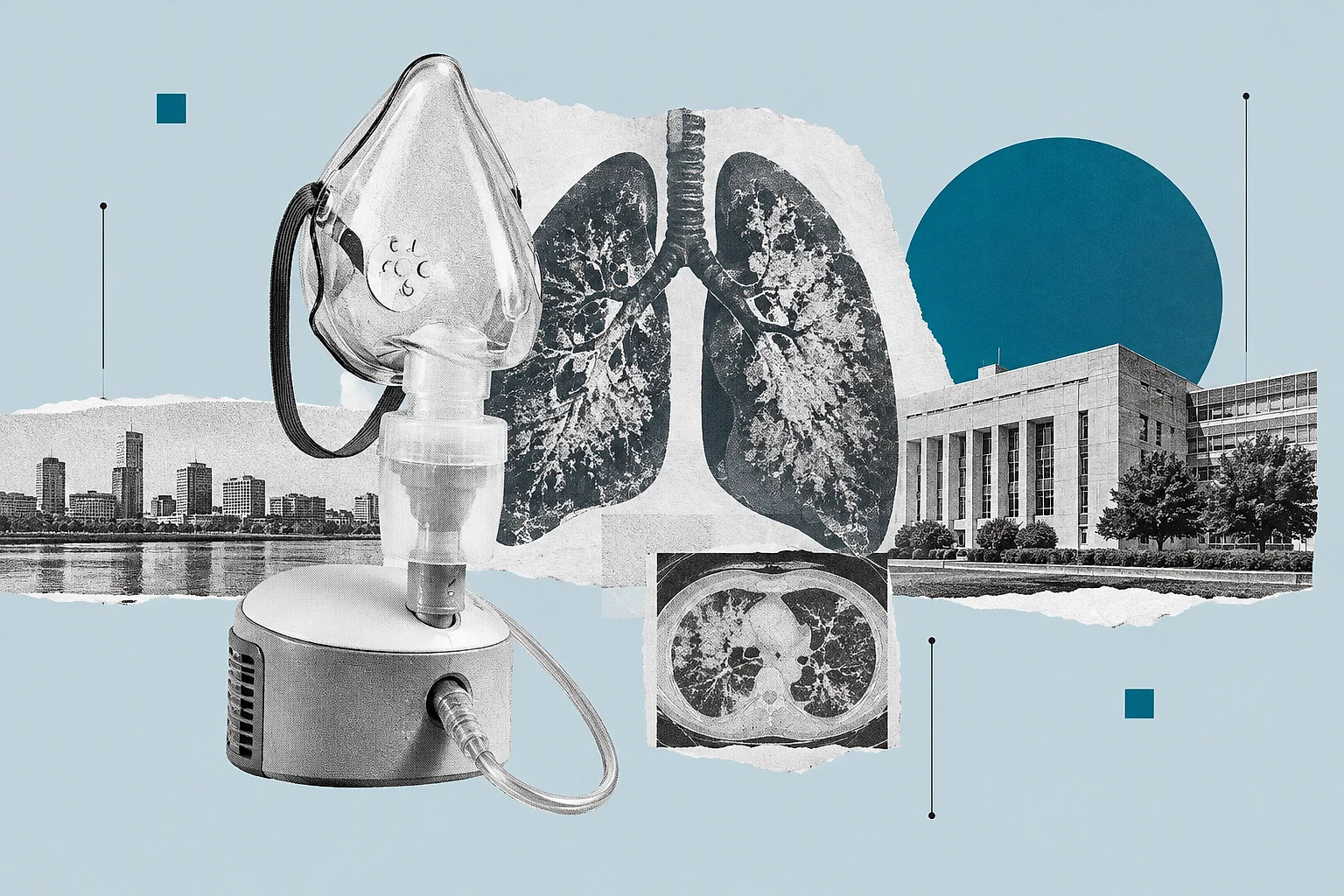
No approval, no rejection, no new date. Patients with autoimmune pulmonary alveolar proteinosis, who now endure lung "washing" under general anesthesia, are left in limbo as Savara's inhaled molgramostim stalls at the finish line.
WASHINGTON
Today was supposed to be the day.
For the few thousand Americans living with autoimmune pulmonary alveolar proteinosis, a rare disease that slowly fills the lungs with a thick, milky protein sludge, Sunday, November 22, 2026, was circled on the calendar. It was the date by which the U.S. Food and Drug Administration had promised to decide on molgramostim, an inhaled drug that could become the first medicine ever approved in America for their condition. Instead, the date came and went in silence.
On Friday morning, Pennsylvania-based Savara Inc., the drug's developer, dropped a bombshell before the stock market opened. The FDA, it said, would not act on its application by the deadline. There was no approval and no rejection. Most unsettling for patients and investors alike, there was no new date.
"The review of the BLA is ongoing and no revised action date has been provided by the agency," the company said in its announcement, according to the Biotech Catalyst Calendar.

A disease that drowns you from the inside
To understand why this delay stings, you have to understand the disease. In healthy lungs, tiny air sacs called alveoli are coated with surfactant, a slick substance that keeps them open. Immune cells called alveolar macrophages constantly clean up the old surfactant, like a cleaning crew that never clocks out. They rely on a signaling protein called GM-CSF to do their job.
In autoimmune PAP, the body turns on itself. The immune system makes antibodies that neutralize GM-CSF. With the signal blocked, the cleaning crew stops working. Surfactant piles up in the air sacs until oxygen struggles to pass into the blood. Patients describe breathlessness, coughing and crushing fatigue. Some end up on supplemental oxygen.
It is rare. Estimates cited by Tech Times put the number of affected people in the U.S. at somewhere between 2,000 and 8,000, with autoimmune disease accounting for about 90% of PAP cases. It typically strikes adults in their 30s, 40s and 50s, people in the prime of their working and family lives.
The brutal treatment: washing out a lung
Today, the main treatment is whole lung lavage, and it is exactly as harsh as it sounds. Patients are put under general anesthesia. One lung is ventilated while doctors fill the other with saline and drain it, over and over, flushing out the built-up surfactant. A 2016 survey of 20 treatment centers reported an average of roughly 15 liters of fluid used per procedure, according to figures cited by Tech Times. Many patients need the procedure repeatedly; Cincinnati Children's says some may need it about once a year.
There is no approved drug for the disease in the United States or the European Union. That is what makes molgramostim, which Savara plans to sell under the brand name Molbreevi, so significant.
How the drug works
Molgramostim is a lab-made version of human GM-CSF, the very signal the disease's antibodies knock out. Rather than an injection, patients breathe it in once a day through a handheld vibrating-mesh nebulizer, delivering the protein straight to the lungs where the cleanup crew needs it.
The idea is simple: flood the lungs with enough GM-CSF to overpower the antibodies and wake up the macrophages so they can clear the backlog.
The FDA clearly saw the promise. The drug has collected Fast Track, Breakthrough Therapy and Orphan Drug designations in the United States, plus orphan status in Europe and an Innovation Passport in the United Kingdom.
The trial that raised hopes
The case for approval rests on IMPALA-2, a phase 3 trial that enrolled 164 patients. Eighty-one received inhaled molgramostim and 83 received a placebo, in a randomized, double-blind design. The results were published in the New England Journal of Medicine in August 2025.
The main measure was a lung test called DLCO, which shows how well oxygen moves from the lungs into the blood. After 24 weeks, patients on molgramostim improved by 9.8 percentage points of the predicted value, compared with 3.8 points on placebo. The difference was highly statistically significant, with a P value below 0.001. By week 48, the gap held: an 11.6-point improvement on the drug versus 4.7 on placebo.
Patients also reported feeling better. On the St. George's Respiratory Questionnaire, a standard measure of breathing-related quality of life, scores improved by 11.5 points on molgramostim versus 4.9 on placebo at 24 weeks. Side effects and serious adverse events were similar in both groups. According to figures cited by Tech Times from Cincinnati Children's, six patients on the drug needed at least one whole lung lavage during the trial, compared with 11 on placebo.
A rocky road to the FDA
Friday's news is the latest twist in a long and bumpy regulatory journey. Savara began submitting its application in December 2024. In May 2025, the FDA issued a "refuse to file" letter, essentially declining to even open the application, because it lacked required chemistry, manufacturing and controls information. Savara said at the time that the letter raised no safety concerns and asked for no new efficacy studies. Its shares plunged 31.7% that day.
The company regrouped, brought in Fujifilm Biotechnologies as its drug substance manufacturer and resubmitted in December 2025. In February 2026, the FDA accepted the application with Priority Review and set a decision date of August 22, 2026.
Then, in April 2026, the FDA classified Savara's responses to its questions as a "major amendment" and pushed the date back three months, to November 22. Savara said the agency had flagged no safety, efficacy or manufacturing concerns at the time.
Now that second date has been missed too, and this time there is nothing to replace it. Under the PDUFA VII commitments, a major amendment can extend a review only once per cycle, and Tech Times noted that Savara's review has already run past that single extension. Biotech Catalyst Calendar summed it up in one sharp line: the FDA "did not move Savara's deadline. It removed it."
The company stays calm
Savara CEO Matt Pauls struck a measured tone. "We appreciate the FDA's continued efforts on our application," he said, as quoted by TheFly. The company said it looks forward to working closely with the agency to complete the review. Savara has not said why the date was missed, and neither the company nor the FDA has said whether open questions relate to the drug, the nebulizer or something else.
Wall Street was less serene. Savara shares had closed at $5.21 on Thursday. On Friday they opened down about 18% at $4.26 before recovering slightly, trading near $4.50 mid-morning, down roughly 13.6%, according to market data cited by Tech Times and Biotech Catalyst Calendar.
There's real money riding on the outcome. According to SEC filings cited by Tech Times, Savara had about $129.6 million in cash and short-term investments as of September 30. Up to roughly $150 million more is tied to approval, including a $75 million payment from RTW Investments that depends on approval by March 31, 2027.

Expert perspective
Analysts are mostly keeping the faith. Jefferies maintained high confidence that the drug will ultimately be approved, according to Tech Times. It suggested that possible manufacturing questions or stretched FDA bandwidth could explain the delay, and that a U.S. launch could slide into early 2027. Guggenheim said it continues to believe the clinical data are sufficient and the earlier manufacturing issues have been addressed.
H.C. Wainwright kept its Buy rating but trimmed its price target from $10 to $9 and lowered its estimated probability of approval from 85% to 75%.
Missed decision dates remain unusual. A PDUFA date is a performance target, not a legal deadline, and law firm Gibson Dunn has reported that the FDA has generally met or exceeded about 90% of its goals in recent years. Still, there is uncomfortable precedent. In April 2025, the FDA missed its date for Stealth BioTherapeutics' elamipretide without setting a new one, and the company eventually received a rejection.
The delay also lands at a turbulent moment for the agency. The FDA is being run by an acting commissioner, Kyle Diamantas, after Marty Makary resigned in May, and the White House this week withdrew its nomination of Heidi Overton to lead the agency. FDA hiring data cited by Tech Times show the drug-review center's headcount fell about 18%, from 6,044 at the start of fiscal 2025 to 4,961 by September 30, 2026. No one has officially linked staffing to this delay.
On the very same day, the agency acted decisively on another file with the same November 22 goal date. It issued a rejection to Capricor's Duchenne muscular dystrophy therapy deramiocel, citing data-integrity concerns, according to Reuters reporting cited by Tech Times. Why the FDA moved on one application and stalled on another has not been explained.
The view from abroad
Patients in other countries may not have to wait as long. Japan approved a different inhaled GM-CSF drug, sargramostim, for autoimmune PAP in April 2024. In the U.K., the Medicines and Healthcare products Regulatory Agency accepted Savara's Molbreevi application under Accelerated Review in April 2026, with a decision expected in the fourth quarter of this year.
What this means for you
If you or a loved one has autoimmune PAP, nothing changes about your care today. Whole lung lavage remains the standard treatment, and anyone with worsening breathlessness should stay in close contact with a pulmonologist.
Ask about testing. A blood test for GM-CSF antibodies can confirm the autoimmune form of the disease, which matters for any future treatment decisions.
The drug is not rejected. The FDA has not turned molgramostim down, and the review is ongoing. Approval could still come at any time, though analysts suggest it may slip into early 2027.
Watch the U.K. A decision from the MHRA is expected by year's end and could be the first major Western green light for the drug.
For investors, the lack of a new date means uncertainty, and uncertainty is what moves the stock.
The bottom line
For years, people with autoimmune PAP have had one main option: being put to sleep while doctors wash out their lungs with liters of salt water. A once-daily inhaled drug that showed clear gains in a major trial seemed tantalizingly close to changing that.
Now, on the very day the FDA was supposed to decide, patients are left staring at a blank space on the calendar. The science looks solid, analysts are still optimistic and the agency hasn't said no. But until the FDA says yes, or says something at all, thousands of Americans whose lungs are slowly filling with sludge will keep waiting.
Published By | Features Editor