Written By | International News Agencies
The Crimean Bridge
World Politics
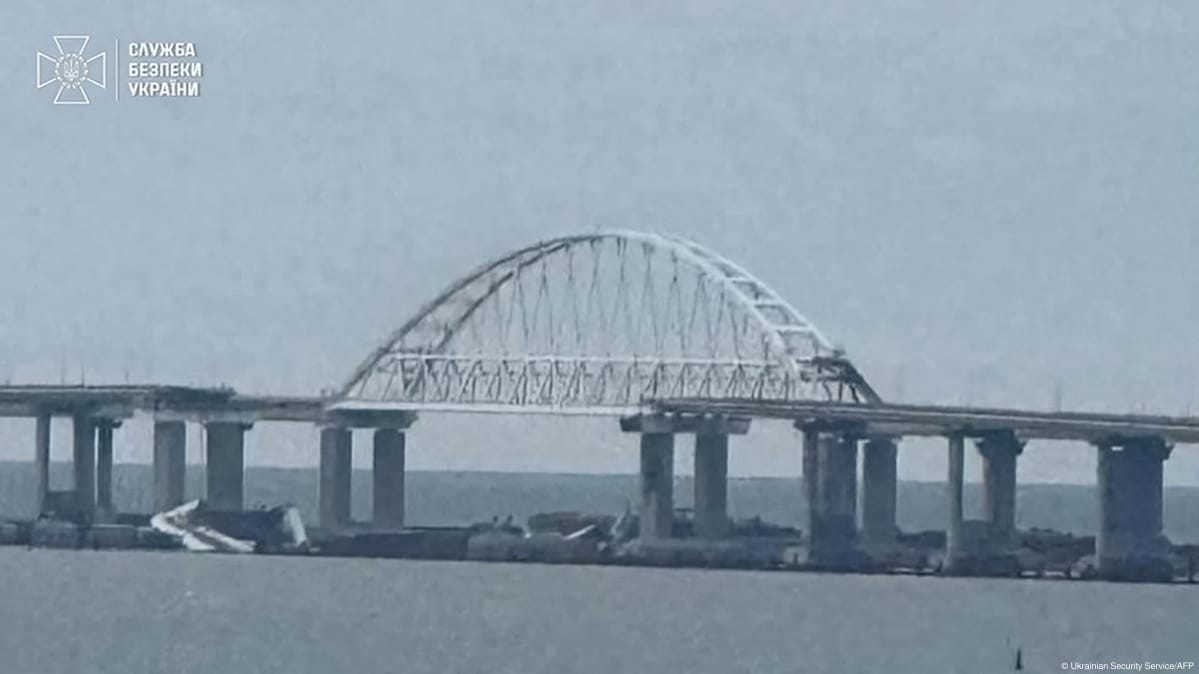
For eight years the Crimean Bridge has been the most visible monument to Vladimir Putin's annexation of Crimea, a 19-kilometre road and rail link across the Kerch Strait that he personally opened in 2018 by driving the first convoy across it. Overnight on November 17, after a second consecutive night of Ukrainian attacks, a section of that bridge was lying in the sea. Ukraine's General Staff and its Security Service (SBU) said one metal arch and the road span beneath it had been completely destroyed, putting the road section out of service and leaving the adjacent railway arch standing but damaged. Russian authorities suspended both road and rail traffic and opened a terrorism investigation, even as the Kremlin had described the previous night's damage as "minor."
The strike is the most damaging blow yet to a structure Ukraine has attacked repeatedly since 2022, and it lands at a politically sensitive moment: days after the first U.S.-led peace talks in nine months ended in Abu Dhabi without a ceasefire, and only two days before Putin is due to sit down with Donald Trump and Xi Jinping in Shenzhen. It also came as Russia escalated its own campaign against Ukraine's bridges, striking the North and South bridges over the Dnipro River in Kyiv in what Ukrainian officials describe as an attempt to split the country in two.
Background: A Bridge That Became a Target
Russia began building the bridge after it seized and annexed Crimea in 2014. The road section opened in 2018 and passenger rail followed in 2019, at a cost of roughly 228 billion rubles, or about $3.7 billion to $4 billion depending on the exchange rate used. Beyond its symbolism as the physical seal on the annexation, it became a central logistics artery after Russia's full-scale invasion in February 2022, carrying fuel, ammunition, equipment and personnel to Crimea and onward to Russian forces in southern Ukraine.
Ukraine has struck the bridge several times. In October 2022 a truck bomb exploded on the roadway and ignited fuel tankers on a passing train; accounts of the death toll differ, with reports citing three, four or five people killed. The SBU later acknowledged responsibility, and its former chief said the bomb contained 21 tonnes of explosives disguised as building materials. Putin called that attack "terrorism" and vowed retaliation. In July 2023 Ukrainian Sea Baby naval drones damaged the road section again, and in June 2025 the SBU said it detonated more than a tonne of TNT-equivalent explosives underwater against the bridge's supports. None of those attacks took the bridge out of service for long. Russia responded by ringing it with air defences, electronic warfare systems, floating barriers, barges and booms.
Over time, the bridge has become somewhat less essential to Russia's military logistics because Moscow now relies heavily on the "land bridge" through occupied southern Ukraine. But Ukraine has been chipping away at that route too. The General Staff said that this autumn bridges at Chonhar and Henichesk, which connect Crimea to the occupied mainland, had also been brought down.
Key Developments: Two Nights, Record Drone Numbers
The assault unfolded over two nights. On the night of November 15 to 16, Ukraine launched what Russia's own figures suggest was its largest drone attack of the war. Russia's Defence Ministry said it intercepted 1,336 drones overnight across several regions, breaking its previous record of 1,254 set on October 29, and claimed 2,049 drones, four Flamingo cruise missiles and seven guided aerial bombs over a 24-hour period. Moscow Mayor Sergei Sobyanin said about 600 drones had been directed at the capital region. These figures are Russian claims and have not been independently verified.
During that first wave, at around 5:38 a.m. local time on November 16, at least one drone struck the bridge's road arch. Sergei Aksyonov, the Moscow-installed head of Crimea, confirmed the attack and announced traffic restrictions. Russian state television footage, later reportedly removed, showed visible deformation of the main road span, and satellite imagery showed damage around the arch. Around 2,000 vehicles were reportedly stranded on either side during inspections, and rail services were delayed. Kremlin spokesman Dmitry Peskov called the damage "minor" and said traffic was continuing, and Russian media reported a partial reopening that afternoon.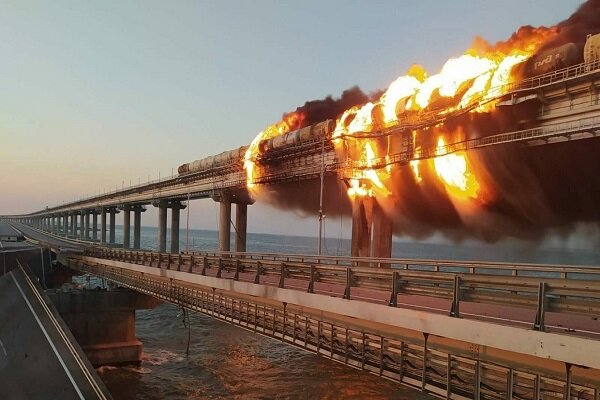
The second wave came the following night. Russia's Defence Ministry said it shot down 1,441 drones over 22 regions, a new record, while Sobyanin said around 800 drones flew toward Moscow. Unverified eyewitness video appeared to show the 227-metre road arch being hit and then collapsing into the strait. By morning, Ukraine's General Staff wrote on Telegram that "the arch and span of the bridge's road section collapsed," adding that "the railway section is still standing, but its arch has already been damaged." Russia's Transport Ministry confirmed that road and rail traffic had been halted and said preliminary information showed no casualties on the bridge. Russian-installed authorities separately reported two people killed in a drone attack in Crimea's Leninsky district.
Ukraine described a carefully staged operation. The General Staff said it was a multi-stage joint operation carried out over several weeks in which Ukrainian forces first neutralised air defence, electronic warfare and radar systems before delivering a final strike with Ukrainian-developed weapons. Units named include the 1st Separate Unmanned Systems Center and the 7th Deep Strike Center of the 414th Separate Unmanned Systems Brigade, known as "Magyar's Birds," which overloaded air defences and relayed signals for the final missile strike. The SBU said its part lasted about a month in seven stages and that, at the final stage, its Alpha special forces struck the road section with Palianytsia missile drones, its fourth strike on the bridge since 2022. Separately, the Ukrainian armed forces and open-source investigators circulated footage reportedly taken from an FP-5 Flamingo cruise missile moments before impact. Exactly which weapons caused the collapse has not been independently established, and accounts differ on whether a missile, missile drones or both delivered the decisive blow.
Russia's Bridge War on the Dnipro
The attack on the Crimean Bridge did not happen in isolation. Russia has intensified strikes on Ukrainian infrastructure this autumn, with a particular focus on bridges over the Dnipro, the river that runs north to south through Kyiv, Dnipro, Zaporizhzhia and Kherson and forms the front line in the south. Overnight on November 17, Kyiv Mayor Vitali Klitschko reported "impacts" on the capital's North and South bridges and partial damage to the metro, causing power and water outages and transport restrictions. Russia's Defence Ministry confirmed it had targeted transport, military and energy facilities in Kyiv, Zaporizhzhia, Cherkasy and Dnipropetrovsk regions. Deputy Energy Minister Artem Nekrasov said consumers in eight regions lost power, and officials reported three injured in Cherkasy region. Reporting on casualties in Kyiv from the past several days of strikes varies by outlet, and some summaries cite at least seven people killed in recent raids on the capital and tens of thousands losing electricity.
President Volodymyr Zelensky warned European partners last week that Russia was preparing sustained attacks on Dnipro crossings in order to "divide Ukraine along the Dnipro river." A senior Ukrainian official said Moscow also aims to cut power flows from western to eastern Ukraine, which could leave millions without electricity this winter.
Reactions
Zelensky confirmed the Crimean Bridge attack and framed it as a direct response to Russia's strikes on Ukrainian infrastructure, including bridges, writing on X that Russia should be reminded that "war will always return to where it began." Vladyslav Vlasiuk, Ukraine's presidential sanctions commissioner, posted a two-line verdict: "Crimean Bridge. Sanctioned." The General Staff invoked Ukraine's right to self-defence under Article 51 of the UN Charter and argued that "the number of land routes available to the occupiers to reach Crimea is steadily decreasing."
In Moscow, the response has been more muted than the scale of the damage might suggest. Peskov's description of the first night's damage as minor has been overtaken by events, and Putin was reportedly briefed on the second strike ahead of his trip to China. Russia's Investigative Committee opened a terrorism case. Pro-Kremlin war correspondent Alexander Kots acknowledged that bridges to Crimea had been "systematically attacked recently." Western governments had not issued substantive public reactions by the time of writing.
Why It Matters
The practical consequences depend on how long the road section stays closed. BBC Russian military analyst Ilya Abishev noted that a prolonged closure would push traffic onto ferries and the land route through occupied southern Ukraine, both of which are themselves vulnerable to Ukrainian strikes. Ferries in the Kerch Strait have been attacked repeatedly because they carry flammable and explosive military cargo, which had made the bridge more important to Moscow. Debris in the navigation channel, which is the only channel through the strait, could also complicate shipping between the Black Sea and the Sea of Azov, although the full extent of the obstruction is not yet clear.
The symbolism is harder to repair. The bridge is a personal prestige project for Putin, and its partial collapse undercuts years of investment in protecting it. Analysts at The War Zone noted that the success of the attack raises questions about the effectiveness of Russian air defences and may encourage Ukraine to strike the weakened structure again, while forcing Russia to divert more resources to defending it.
What's Next
Diplomatically, the timing is awkward for everyone. The U.S.-brokered Abu Dhabi talks produced a prisoner exchange but no ceasefire, and both sides have since escalated their campaigns against each other's infrastructure. On November 19 Putin is scheduled to meet Trump and Xi in Shenzhen on the sidelines of APEC, a summit U.S. officials have said will focus on nuclear arms control and strategic stability rather than Ukraine. The bridge strike gives Putin a grievance to raise and Kyiv a demonstration of reach, but it is unlikely to change the stated agenda.
On the ground, the key questions are how quickly Russia can repair or bypass the destroyed road span, whether the damaged rail arch remains usable, and whether Moscow escalates its strikes on Dnipro bridges in retaliation. With winter approaching and both sides targeting the arteries that keep the other's economy and army moving, the war has become, quite literally, a battle over bridges.